









Picking errors are quiet profit-killers.
They don't show up as a single dramatic line item, but they nibble away at your margins one wrong item at a time. Every mispick means a return, a re-ship, and maybe a customer you never see again. A few of those a week add up faster than you'd like.
So what actually fixes it? A warehouse management system (WMS) is the system that improves picking accuracy. It's built to make sure the right item ends up in the right box, every time.
In this article, we'll walk through what causes picking errors, how a WMS fixes them, and the tech working behind the scenes. Then we'll show you how to choose the right system for your business. Let's dig in.
Key Takeaways
- A warehouse management system (WMS) runs receiving, put-away, picking, packing, and shipping, and it's the system that improves picking accuracy most.
- It works by validating every pick (barcode or RFID), guiding pickers, and syncing inventory in real time.
- In our experience, manual, unvalidated processes are behind most picking errors (aka mispicks).
- Scan validation is going mainstream: in 2024, 58% of 3PL warehouses surveyed by Extensiv used mobile barcode scanning.
- The best fit for scaling product businesses is an integrated WMS built into an inventory management system (IMS).
What Is a Warehouse Management System (WMS)?
A warehouse management system is software that controls your daily warehouse operations. Think receiving, put-away, picking, packing, and shipping, all tracked and coordinated in one place. It's the system of record for where your stock lives and how it moves.
WMS vs. Inventory Management System vs. ERP
Here's where it gets a little confusing, so let's clear it up. A WMS handles the four walls of your warehouse. An inventory management system (IMS) goes broader, and an ERP goes broadest of all.
| System | Scope | What It Manages | Best For |
|---|---|---|---|
| WMS | Inside the warehouse | Receiving, put-away, picking, packing, and shipping | Teams focused on warehouse speed and accuracy |
| IMS | Across the whole business | Stock, sales, purchasing, and channels across every location | Product businesses selling across multiple channels |
| ERP | Enterprise-wide | Finance, HR, and operations across the business | Large enterprises that want one suite for everything |
Cin7 sits in the sweet spot. We're an IMS with built-in WMS capability, so you get warehouse-level control and business-wide visibility without the bloat. And to be crystal clear: we're not an ERP.
Some folks call us "ERP Lite," which we'll happily take. The point is you get the power you need without the overhead you don't.
Why Picking Accuracy Makes or Breaks Your Warehouse
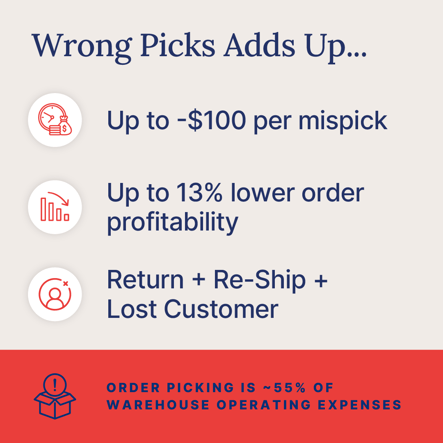
Order picking is the beating heart of your warehouse, and it's also the most expensive part. According to Bartholdi and Hackman's Warehouse & Distribution Science, picking typically accounts for about 55% of warehouse operating costs. That's more than half your budget riding on one activity, so getting it wrong hits hard.
And it does go wrong. Every wrong pick eats into the margin on that order, and the losses stack up fast across dozens of orders a week. Ouch.
The pain doesn't stop at the invoice, either. One wrong pick sets off a chain reaction: a return, a re-ship, a support ticket, and a customer wondering if you've got your act together. Trust is hard to earn and easy to lose over a shipping mix-up.
What Causes Picking Errors in a Warehouse?
In our experience, most picking errors, or mispicks, come from processes rather than people. A mispick is any time the wrong item, the wrong quantity, or the wrong location ends up on an order. The usual culprits are manual workflows, look-alike SKUs, messy layouts, bad stock data, rushed pickers, and no scan check.
It's usually not careless people. It's careless processes. When you ask people to track stock in their heads and on spreadsheets, mistakes are baked in.
Here are the most common causes, and how a WMS fixes each one:
- Manual or paper processes leave pickers working from printouts and memory. A WMS sends digital pick lists to a mobile device instead.
- Look-alike SKUs and poor labeling make it easy to grab the wrong size or color. Scan validation catches the swap before it ships.
- Bad slotting or layout puts similar items side by side and sends pickers on confusing routes. A WMS guides slotting and walk paths.
- Inaccurate stock data sends pickers to empty bins or the wrong shelf. Real-time inventory sync keeps the system and the shelf in agreement.
- Rushed or untrained pickers cut corners when volume spikes. Guided picking tells them exactly where to go and what to grab.
- No scan validation means nobody checks the item against the order. A WMS confirms every SKU and quantity at the pick and at packing.
What Warehouse System Improves Picking Accuracy?
A warehouse management system (WMS) is the system that improves picking accuracy. It's purpose-built to eliminate the guesswork that leads to wrong picks, and it does the job in four connected ways.
First, it validates every pick, checking the item in a picker's hand against the item on the order. Second, it guides pickers through the warehouse so they aren't relying on memory or wandering the aisles.
Third, it keeps inventory data accurate and real time, so the stock the system shows is the stock actually on the shelf. And fourth, it supports accuracy technologies like barcode scanning, pick-to-light, voice, and RFID that catch errors before they ship.
A WMS is strongest when it's built into an IMS. Why? Because a lot of picking errors trace back to disconnected data, where your warehouse doesn't know what your sales channels are doing.
Benefits of a Warehouse Management System Beyond Accuracy
Fewer mispicks are the headline, but they're not the only perk. A good WMS also brings:
- Real-time visibility into what's on hand, where it lives, and what's already promised to a customer.
- Faster fulfillment, since connected order management gets orders to pickers as soon as they come in.
- Lower labor cost per order, because the same team picks more orders with fewer do-overs.
- Better space use, with slotting that keeps fast-movers close and slow-movers out of the way.
- Scalability across locations and channels, so adding a warehouse or marketplace doesn't mean adding chaos.
How a WMS Improves Picking Accuracy
The "what" is straightforward. The "how" is where the real value lives, and it's the part most guides skip. Here are the mechanisms that actually move the needle.
Real-Time, Connected Inventory Data
Accurate picking starts with data you can trust. When your systems don't talk, pickers head to the wrong shelf, chase phantom stock, or pull a unit that's already promised elsewhere.
Manual tracking makes it worse, which is why learning how to improve inventory accuracy pays off before you ever touch a scanner. Every pick is only as good as the stock count behind it.
A WMS fixes this by syncing your stock across channels and locations in real time, so what the screen says matches what's on the shelf. At Cin7, our 700-plus integrations with tools like Shopify, Amazon, QuickBooks, and Xero keep everything on the same page. That connected data is the foundation every accurate pick is built on.
Barcode Scanning and Order Validation
Here's the mechanism that does the heavy lifting: scan-based validation. Every pick gets scanned and checked against the order, and the system flags a mismatch before it ever reaches the packing station. No more eyeballing a SKU and hoping for the best.
So how does barcode scanning work in a WMS? It usually follows four steps:
- The WMS releases the order to a picker's mobile device or handheld scanner.
- The picker scans the bin location to confirm they're in the right spot.
- The picker scans the item, and the WMS confirms the SKU and quantity match the order.
- The order gets verified again at packing before it ships.
It's a proven approach, too. In Extensiv's 2024 3PL Warehouse Benchmark Report, 58% of 3PL warehouses used mobile barcode scanning, up from 51%. It takes memory out of the equation, which is exactly the point.
Cin7's WMS uses wireless barcode scanning (via ScanSKU) to make picking simple and validate orders on the spot. We recommend ScanSKU hardware, but most Bluetooth scanners and mobile phones work too. Scan, confirm, done.
If something's off, you'll know right away instead of hearing about it from an unhappy customer.
Guided Picking and Optimized Walk Paths
A rushed picker is an error-prone picker. When people have to figure out their own route through the warehouse, they backtrack, they hurry, and they make mistakes. Guided picking takes that pressure off by routing pickers along the most efficient path and telling them exactly where to go next.
There's a nice side effect: speed. Cin7's guided walk paths cut picking times by up to 40% and put an end to "warehouse wandering." Less hurrying means fewer fatigue-driven slip-ups during a long, winding shift.
Your layout matters just as much as your route. Storing look-alike items side by side is practically an invitation to mispick, so separate them and give every bin a clear, scannable label. Pair that with smart slotting, where your fast-movers sit closest to packing, and you cut travel time and errors at once.
Pick-to-Light, Voice, and RFID
For higher-volume operations, a few technologies push accuracy even further. Pick-to-light uses illuminated prompts to point pickers to the exact bin, and voice picking guides them hands-free through headsets. RFID lets you verify items in bulk without scanning each one individually.
The industry numbers look impressive. MHI's pick-to-light solutions guide lists 99.9+% accuracy rates among typical benefits, though that's an industry claim and your mileage may vary.
Just remember that these tools don't replace your WMS. They layer on top of it, and the WMS is the connective platform that makes them all work together.
Picking Methods That Support Accuracy
Beyond the tech, how you organize the actual picking matters. Each common method comes with its own accuracy trade-offs, and a WMS handles each one a little differently.
Batch Picking
Batch picking has one person grab items for several orders in a single trip. It's efficient, but orders can get crossed if nothing checks which item goes where. A WMS assigns each item to its order and validates it with a scan, so nothing lands in the wrong tote.
Zone Picking
Zone picking assigns each worker a section of the warehouse, so they get fast and familiar with their area. The risk shows up at the end, when partial orders from different zones need careful consolidation. A WMS tracks every zone's picks and flags incomplete orders before they ship.
Wave Picking
Wave picking groups orders by priority or shipping schedule, balancing speed with control. The catch is that a big wave can swamp your pickers and invite rushed mistakes. A WMS releases waves in manageable chunks and validates each pick along the way.
Discrete (Single-Order) Picking
Discrete picking is the simplest method: one picker, one order, start to finish. It's easy to get right, but it means more walking, and tired pickers make more mistakes. A WMS keeps it accurate with optimized routes and a scan check on every item.
There's no single "most accurate" method, because the right choice depends on your order profile and layout. The good news is a WMS orchestrates whichever method you pick, assigning work intelligently and validating each item along the way. So the method sets the strategy, and the WMS keeps it honest.
Types of Warehouse Management Systems
Not all WMS solutions are built the same, and the type you choose shapes how well it fits your business. There are three main flavors, and each makes a different trade-off on accuracy.
Standalone WMS
A standalone WMS runs only your warehouse and lives apart from your other software. It's powerful inside the four walls, but you'll need integrations to keep sales and stock data in sync. The accuracy catch is that if those integrations lag, pickers end up working from stale numbers.
Cloud-Based WMS
A cloud-based WMS lives online, so you get real-time access and automatic updates without managing servers. Your team can pick from mobile devices anywhere in the building. The accuracy catch is that it's only as connected as the rest of your tech stack.
Integrated WMS (Built Into an IMS or ERP)
An integrated WMS comes built into a broader IMS or ERP, connecting your warehouse to sales, purchasing, and accounting. Because everything shares one set of data, it sidesteps the disconnected-data problem behind so many mispicks. The accuracy catch is that some big ERP suites bundle so much that warehouse features feel like an afterthought.
For scaling product sellers juggling multiple sales channels, an integrated cloud WMS is usually the smart move. That's exactly the ground Cin7 is built for. We're an integrated cloud IMS with built-in WMS, made for fast-growing omnichannel businesses like wholesale and distribution brands that can't afford to let accuracy slip.
How to Choose the Right Warehouse Management System
The right warehouse management system is the one that fits how you actually pick, sell, and grow. Start by checking whether you need one at all. Then hold every vendor up against the same checklist.
Signs You Need a Warehouse Management System
- Mispicks are rising, and returns and re-ships are eating into your margins.
- Your stock counts don't match what's actually on the shelf.
- You keep hiring more pickers just to keep up with order volume.
- You're adding a second warehouse location or a new sales channel.
- You're still running your warehouse on spreadsheets.
Sound familiar? If two or more of those hit home, it's time to shop around.
What to Look for in a WMS Before You Sign a Contract
Before you commit to a long-term contract, make sure the system checks these boxes:
- Scan validation and mobile picking, so every SKU and quantity gets confirmed before it ships.
- Real-time multi-location sync, so every warehouse sees the same stock numbers.
- Integrations with your e-commerce platforms, marketplaces, accounting software, and 3PL partners.
- Support for your picking methods, whether that's batch, zone, wave, or discrete.
- Reporting on accuracy KPIs like picking accuracy, mispick rate, and picks per hour.
- Cloud deployment and scalability, so the system grows with you instead of holding you back.
- Clear total cost and contract terms, starting with transparent pricing and no surprise add-ons.
- Implementation and support that get your team up and running without a months-long slog.
How to Measure Picking Accuracy
You can't improve what you don't measure, so let's talk numbers. Picking accuracy has a simple formula:
Picking accuracy (%) = (Correct picks ÷ Total picks) × 100
Say your team made 5,000 picks last month and 4,950 were correct. That's 4,950 ÷ 5,000 × 100, or 99% picking accuracy.
What's a good score? We'd suggest aiming for 99% or higher. For reference, WERC's 2025 DC Measures put best-in-class order-picking accuracy at 99.68% or higher, so there's real headroom if you invest in the right tools.
Picking accuracy shouldn't travel alone, either. Track it alongside other picking KPIs like picks per hour to get the full picture of both speed and quality.
| KPI | What It Tells You |
|---|---|
| Picking accuracy | The share of picks with the right item in the right quantity. |
| Picks per hour | How many picks a worker completes in an hour. |
| Order cycle time | How long an order takes to go from release to ready-to-ship. |
| Mispick rate | The share of picks that were wrong, the flip side of picking accuracy. |
A WMS surfaces these KPIs automatically. Instead of building spreadsheets by hand, you get live reporting and analytics that show exactly how your warehouse is performing.
How Cin7's Warehouse Management System Improves Picking Accuracy
Let's bring it all together. Cin7 combines real-time connected inventory, wireless barcode scanning with order validation, and guided picking in one IMS. Your data stays trustworthy, every pick gets checked, and your team always knows where to go.
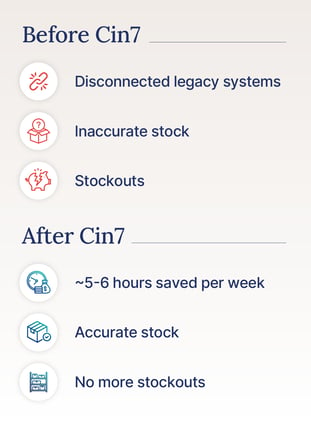
Just ask Changing Habits, where one team member now saves around 5 to 6 hours a week managing stock. The organic nutrition brand made the move from Unleashed to Cin7 Core, and the stockouts stopped.
Before the switch, their stock-on-hand numbers were inaccurate, which led to stockouts. The team had to manually check an offsite warehouse just to trust their own data. Not exactly a recipe for calm.
Now the numbers add up on their own, so those manual warehouse checks are gone. As the team puts it, they're "not running out of stock like we used to."
If you're tired of second-guessing your inventory and want picking accuracy you can count on, we'd love to show you how it works. Request a demo and see it in action.
Frequently Asked Questions
What Warehouse System Improves Picking Accuracy?
A warehouse management system (WMS) is the system that improves picking accuracy. It does it through scan-based validation, guided picking, and real-time inventory data that keeps every pick honest.
How Does a WMS Reduce Picking Errors?
A WMS validates every pick against the order, flagging mismatches before they ship. That removes the manual guesswork and memory-based mistakes that cause most picking errors in the first place.
What Is a Good Picking Accuracy Rate?
Aim for 99% or higher. Best-in-class operations hit 99.68% or higher in WERC's 2025 DC Measures, so if you're below that, there's clear room to improve with the right technology.
Is a WMS the Same as an ERP or an Inventory Management System?
Not quite. A WMS can stand alone or live inside an inventory management system (IMS), while an ERP covers finance, HR, and operations across the whole business. Cin7 is an IMS with a built-in WMS, and to be clear, we're not an ERP.
How Much Do Picking Errors Cost?
More than you'd think. Picking typically makes up about 55% of warehouse operating costs, and every wrong pick piles a return, a re-ship, and a frustrated customer on top. Those small slips add up quickly.
More from the blog
View All Posts
What is a Warehouse Management System (WMS)? + 5 Best Options
Read More
Warehouse Layout Design: Types, Best Practices, and How to Plan Yours
Read More