







Inventory Management Software for Growing Companies
.png?width=510&height=267&name=0601_IMGGrowingCompanies%20(1).png)
If your product-based business is outgrowing spreadsheets and basic tools, the best inventory management software is one that scales with you, not one you'll need to replace in eighteen months.
That's exactly why we built Cin7: a connected inventory management system that grows alongside your business, from your first multichannel sale to your thousandth SKU.
Choosing inventory management software at the growth stage is one of the most consequential decisions you'll make. Get it right and you unlock real-time visibility, automation, and the confidence to expand into new channels. Get it wrong and you're back to square one, re-migrating data and re-training your team. This guide walks you through what to look for, how to match features to your growth stage, and how the leading platforms compare.
Key Takeaways
- The best inventory management software for a growing company scales across all your sales channels, warehouses, and fulfillment partners without forcing a platform switch.
- Look for an IMS with 700+ integrations so your entire tech stack (accounting, e-commerce, marketplaces, shipping) stays connected in real time.
- AI-driven demand forecasting helps you buy smarter, reduce overstock, and avoid stockouts before they happen.
- A modern IMS is built for a faster rollout than a full ERP, with guided onboarding instead of a months-long project.
- Real-time inventory sync is non-negotiable once you're selling on multiple channels or shipping from more than one location.
Why Do Growing Companies Need Inventory Management Software?
Inventory management software (IMS) is a platform that tracks your products across every sales channel, warehouse, and fulfillment partner in real time.
Growing companies need it because spreadsheets work great until they don't.
Maybe you started with a single Shopify store and a Google Sheet that tracked everything just fine. But now you've added Amazon, you're shipping from two warehouses, and your accountant is asking why the numbers don't match. Sound familiar?
That's the growth inflection point. It's the moment when manual processes start costing you money through overselling, stockouts, mis-ships, and hours spent reconciling data across disconnected systems. According to IHL Group, the global retail industry loses an estimated $1.73 trillion annually to inventory distortion (the combined cost of stockouts and overstocks), representing about 6.5% of retail sales. While this figure covers retail businesses of all sizes globally, it underscores just how costly poor inventory visibility can be.
If you're still juggling manual processes, you've got plenty of company. In Capterra's February 2026 software-buyer data, about 34% of the SMBs it spoke with rely on manual methods for inventory, and another 24% depend on spreadsheets. Dedicated inventory management software replaces that patchwork with a single source of truth: one platform that connects your sales channels, warehouses, accounting, and fulfillment in real time.
The good news? You don't need an enterprise-grade ERP to solve this. Modern IMS platforms are built specifically for product-based businesses that need power without the complexity (or the six-figure price tag).
What to Look for at Every Growth Stage
Not every growing company needs the same features on day one. Here's a stage-by-stage framework to help you prioritize what matters most right now and what you'll need next.
Early Growth: Moving Off Spreadsheets (1-25 Employees)
You've proven product-market fit, orders are climbing, and your spreadsheet is starting to buckle under the weight. At this stage, you need:
- Centralized inventory tracking across your sales channels so you're not overselling
- Basic integrations with your accounting software (QuickBooks or Xero) and your primary sales channel (Shopify, Amazon, or your own store)
- Simple purchase order management to keep suppliers organized
- Low onboarding friction because you don't have a dedicated IT team, so the platform needs to be intuitive
The trigger to move: once you're spending more than a few hours a week updating stock counts across multiple tabs or platforms, it's time.
If you're just getting started, free or entry-level tools like Zoho Inventory or inFlow can be a fine starting point for inventory management software for small business needs. They'll help you centralize basic tracking without a big upfront investment. But watch for the signals that it's time to graduate: if you're adding a second sales channel, running into sync issues, or spending hours on manual workarounds, you'll want a scalable IMS that won't hold you back as you grow.
Scaling Operations: Multichannel and Multi-Warehouse (25-100 Employees)
You're selling across three or more channels, possibly shipping from multiple warehouses or using a 3PL, and order volume has outpaced what basic tools can handle. Now you need:
- Real-time inventory sync across every channel. When a unit sells on Amazon, your Shopify and wholesale quantities update instantly
- Multi-warehouse management with bin/location tracking so your team picks, packs, and ships accurately
- Automated workflows for purchase orders, reorder points, and routing
- Robust integrations with your full tech stack, not just one or two connectors, but a platform that plays nicely with your shipping, accounting, e-commerce, and marketplace tools
- Reporting and analytics that show you what's selling, what's sitting, and where your cash is tied up
The trigger to move: once you hit three or more sales channels, or you're managing inventory across more than one location, real-time sync isn't a nice-to-have. It's essential for multichannel selling at scale.
Advanced Scaling: Complex Supply Chains (100+ Employees)
Your operations span multiple countries, you're managing manufacturing or kitting, and you need enterprise-level visibility without enterprise-level headaches. At this stage, look for:
- EDI (Electronic Data Interchange) for automated communication with major retailers
- Built-in or connected manufacturing and BOM (Bill of Materials) management
- AI-driven demand forecasting that helps you buy smarter and reduce excess stock
- B2B portals for wholesale ordering, allowing your buyers to place orders directly without emails and spreadsheets
- 3PL management to orchestrate fulfillment across third-party logistics partners
- Advanced user permissions and workflows as your team grows across departments and geographies
The trigger to move: when your supply chain touches multiple partners, channels, and countries, you need software that doesn't just track your inventory, it orchestrates it.
Inventory Management Software Comparison: Top Platforms for Growing Companies
Here's how the leading platforms stack up for businesses at the growth stage. We've focused on the capabilities that matter most when you're scaling: multichannel selling, integrations, manufacturing support, and pricing accessibility.
| Software | Best For | Multichannel | Integrations | Manufacturing | Starting Price Range |
|---|---|---|---|---|---|
| Cin7 | Growing businesses scaling across channels | Yes, retail, e-commerce, wholesale, marketplace | 700+ (QuickBooks, Xero, Shopify, Amazon, Walmart, WooCommerce, and more) | Yes | Mid-tier |
| Katana | Product makers | Syncs Shopify, Amazon, wholesale, and retail orders | Unlimited integrations; open API | Yes (core focus); routings are a paid add-on | Free plan (30 SKUs); Core plan from $299/mo, usage-based (as of October 2026) |
| Fishbowl | QuickBooks users | Multichannel selling from the Growth plan | Two-way QuickBooks sync; Xero also supported | Full BOM and MRP on Fishbowl Advanced Manufacturing only | From $229/mo billed annually; manufacturing from $675/mo (as of October 2026) |
| Zoho Inventory | Small businesses, especially Zoho users | Shopify, Amazon, and WooCommerce connectors | Zoho apps plus third-party connectors like QuickBooks Online and Xero | Basic assemblies (composite items) | Free plan available (as of October 2026) |
| inFlow | Small businesses needing simplicity | Shopify, Amazon, WooCommerce, and Squarespace | 95+ integrations | BOM and manufacture orders in inFlow Manufacturing | From $99/mo billed annually; inFlow Manufacturing from $169/mo; 14-day free trial (as of October 2026) |
| NetSuite | Enterprise | Sales channel allocation and multi-location inventory | Contact vendor for details | Work orders, MRP, and assemblies | Not published (contact vendor) |
| Odoo | Businesses wanting open-source flexibility | E-commerce, POS, and Sales apps | Modular apps | Full MRP app | One app free with unlimited users; all apps need a paid plan (as of October 2026) |
| Brightpearl | Retail and wholesale brands | Yes (core strength) | Retail and e-commerce plug-and-play connectors | Limited (BOM and assembly via a partner-built app) | Quote-based; unlimited users (as of October 2026) |
Sources: Competitor details are as of October 2026, per each vendor's own pages: Katana pricing and Shopify App Store listing; Fishbowl pricing; Zoho Inventory pricing and assemblies help doc; inFlow pricing; NetSuite Oracle Help Center; Odoo pricing and Manufacturing app; Brightpearl multichannel, pricing, and Bill of Materials app.
Worth noting: Zoho Inventory's free plan and inFlow's lower entry price make them easy starting points, though you may outgrow them as you add channels. Full ERP suites like NetSuite are powerful, but they're often more system than a growing product business needs. Cin7 is purpose-built for that growth sweet spot: the businesses that need real power but can't afford to wait six months for deployment.
What typically drives IMS pricing? Most platforms tier based on the number of sales channels, users, integrations, and add-on modules (like B2B portals or advanced forecasting). Understanding these factors helps you compare quotes and anticipate costs as you scale.
How Much Does Cin7 Cost?
Cin7 pricing is tiered by plan, so you pay for the users, integrations, and order volume you actually need. Here's what's listed on our Cin7 pricing page (USD, excluding taxes):
- Standard, $349/month. 5 users, 2 e-commerce or app integrations, 6,000 sale orders a year, and unlimited inventory locations.
- Pro, $599/month. 10 users, 4 integrations, 24,000 sale orders a year, and material requirements planning. It's our most popular plan.
- Advanced, $1,199/month. 15 users, 6 integrations, 120,000 sale orders a year, and advanced warehouse management.
Need more room? You can buy extra integrations and users, and we offer custom builds for more complex operations. Get a demo and we'll help you pick the right plan (no guesswork required).
What Features Matter Most for Growing Companies?
Real-Time Inventory Sync Across Every Channel
This is the single most important capability for any business selling on more than one channel.
- When a customer buys your last unit on Amazon, your Shopify store needs to know instantly to avoid overselling.
- Without real-time sync, you're canceling orders and damaging your reputation on the platforms that matter most.
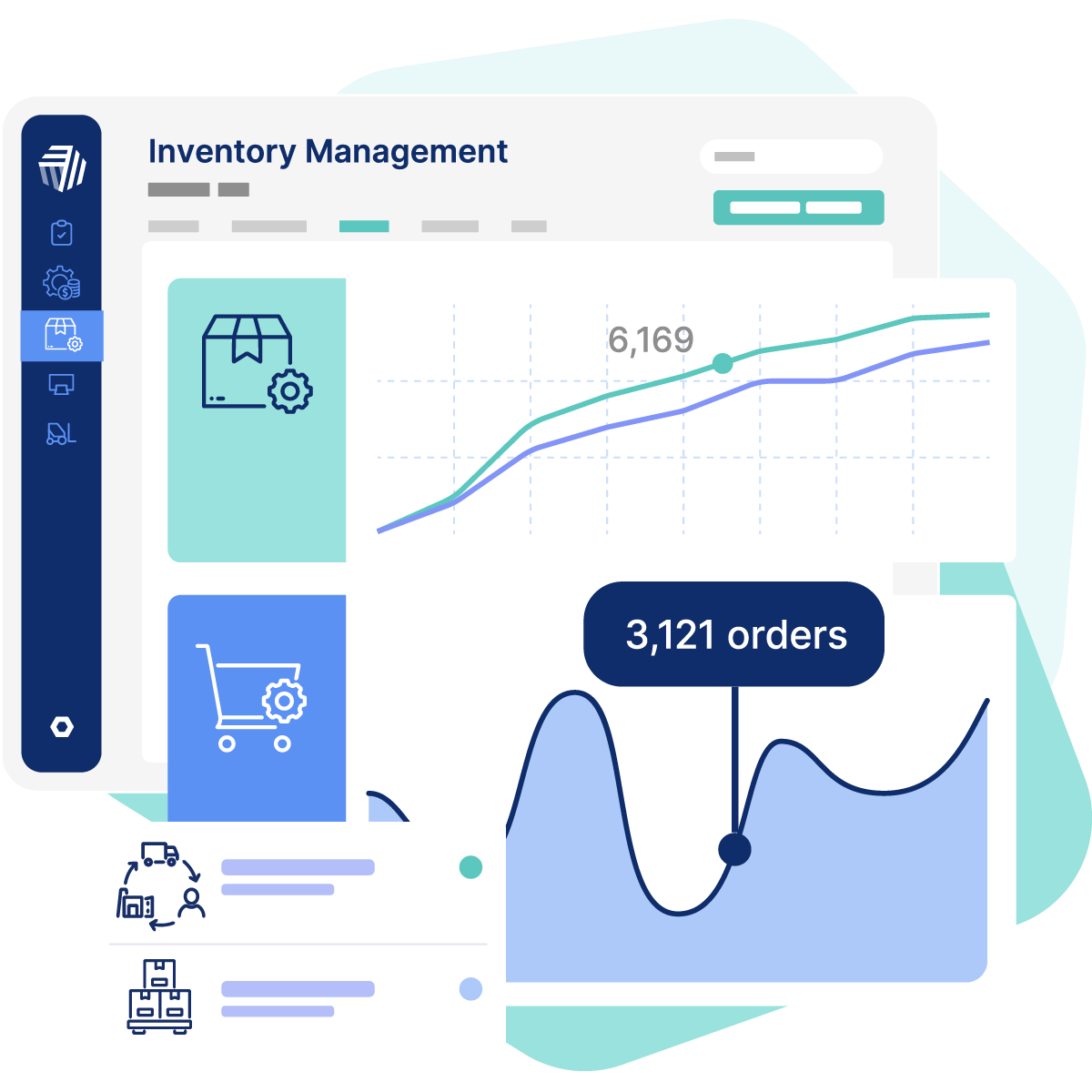
- Cin7 connects to your sales channels, warehouses, and fulfillment partners so your inventory counts update everywhere, in real time, with 700+ integrations including Shopify, Amazon, Walmart, WooCommerce, BigCommerce, eBay, and Faire.
AI-Driven Demand Forecasting
Guessing how much to order is a game you'll always lose.
- Too much inventory ties up cash. Too little means missed sales and frustrated customers.
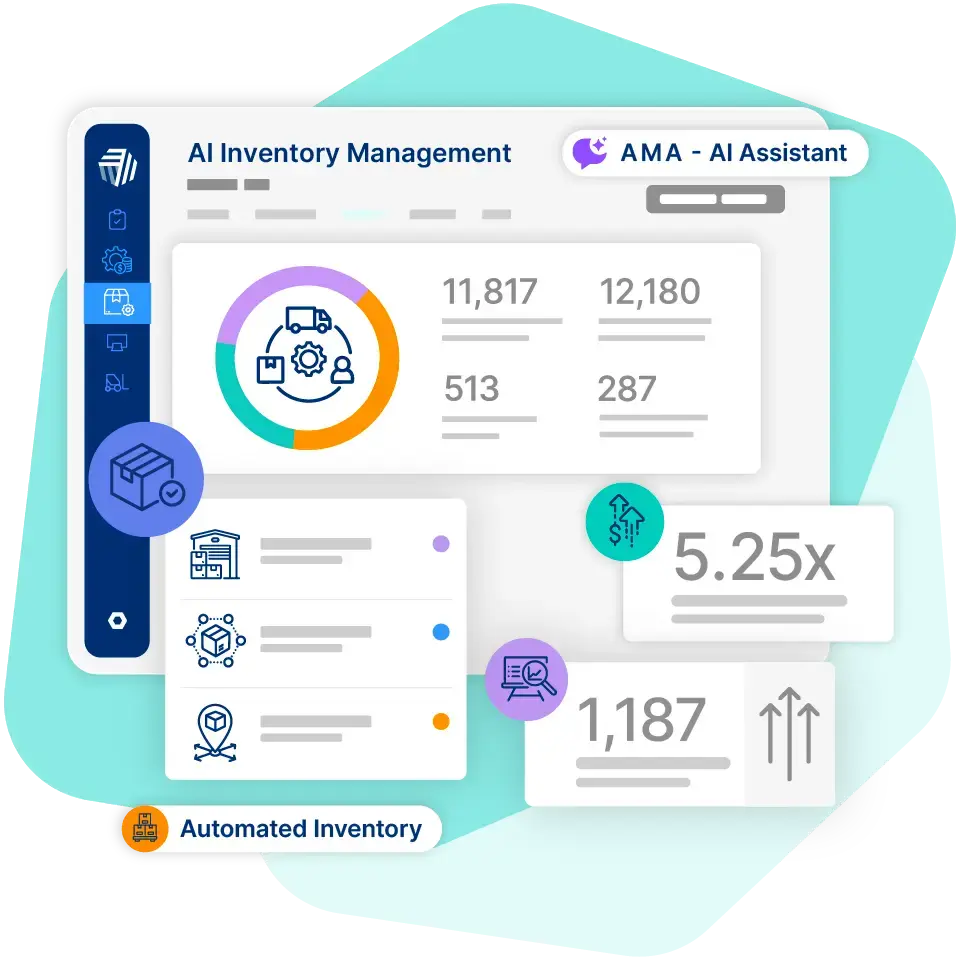
- Cin7's ForesightAI uses your historical sales data, seasonality patterns, and trends to predict demand.
- It's like having an analyst on your team who never takes a day off, helping you buy smarter and reduce excess stock.
B2B Portal for Wholesale
If you sell wholesale, managing orders often means juggling spreadsheets, back-and-forth emails, and manual data entry.
- A built-in B2B portal lets your wholesale buyers browse your catalog, place orders, and track shipments on their own.
- This frees your team from the inbox and reduces errors.
- Shopping for b2b inventory management software? Make sure the portal pulls from the same live stock counts as every other channel.
- It's a big reason wholesalers and distributors pick Cin7 as their inventory software for wholesale.
3PL Connect and Warehouse Management
As you scale, you'll likely work with third-party logistics providers.
- Cin7's 3PL Connect integrates your fulfillment partners directly into your workflow, so orders route automatically and inventory updates flow back in real time.
- If you run your own warehouse, built-in warehouse management with barcode scanning, pick/pack workflows, and bin-level tracking keeps your operation tight.
Point of Sale for Retail
Selling in-store and online? Your IMS should connect both.
- Cin7's built-in POS syncs in-store sales with your online channels.
- You're never working from two separate inventory counts.
How Cin7 Connects to Shopify, Amazon, QuickBooks, and Your 3PL
Good multichannel inventory management software is only as strong as its connections. Here's how Cin7 links up with the tools you probably use every day. (Spoiler: no copy-paste marathons.)
Does Cin7 Work With Shopify?
Yes. Cin7 connects natively to Shopify, so your orders flow into Cin7 and your stock levels stay in sync with your store. Learn more about the Cin7 Shopify integration.
Does Cin7 Integrate With Amazon?
Yes. Cin7 brings your Amazon orders into the same system as your other channels, so one live stock count covers them all. That's how you avoid selling a unit on Amazon that just sold on Shopify. See how the Cin7 Amazon integration works.
Does Cin7 Connect to QuickBooks Online and Xero?
Yes. Cin7 integrates with both, so your sales and purchasing data reach your books without double entry. Your accountant will thank you. Explore the QuickBooks Online integration and the Xero integration.
How Does Cin7 Work With 3PLs?
Cin7 connects your third-party logistics partners directly to your workflow. Orders route to your 3PL automatically, and inventory updates flow back in real time. Find out how 3PL Connect links your fulfillment partners to Cin7.
Common Mistakes When Choosing Inventory Management Software
We've seen thousands of growing businesses go through this evaluation process. Here are the pitfalls that trip up even the savviest operators:
- Buying for today instead of tomorrow. That entry-level tool might check the boxes right now, but will it handle three warehouses and five sales channels in eighteen months? Migration is painful, so choose a platform you can grow into.
- Ignoring integration depth. "We integrate with Shopify" can mean very different things. Some platforms offer basic connectors; others provide deep, real-time data flows. Ask how many integrations the platform supports and how those integrations actually work.
- Underestimating onboarding. The best software in the world doesn't help if your team can't use it. Look for platforms with strong onboarding support, training resources, and a responsive customer success team.
- Skipping the demo. Feature lists and pricing pages only tell part of the story. A live demo lets you see how the platform handles your specific workflows instead of a generic scenario.
Why Growing Companies Choose Cin7
We built Cin7 for exactly the businesses reading this guide: product-based companies that have outgrown their starter tools and need a platform that keeps up.
Here's what sets us apart:
- 700+ integrations connecting your entire tech stack, from QuickBooks and Xero to Shopify, Amazon, Walmart, WooCommerce, BigCommerce, eBay, and Faire. You won't need to rip and replace anything.
- ForesightAI demand forecasting that turns your sales data into buying intelligence, helping you reduce overstock and avoid stockouts.
- Built-in B2B portal so your wholesale customers can order without the back-and-forth.
- 3PL Connect for seamless third-party logistics integration.
- POS that connects your in-store and online inventory in real time.
- Warehouse management with barcode scanning, pick/pack, and bin-level tracking.
- EDI for automated communication with major retailers.
- A platform you won't outgrow. Cin7 scales from early growth through complex, multi-country operations, so you invest in onboarding once and keep building from there.
We're not an enterprise ERP that takes six months to implement. And we're not a basic tool you'll outgrow in a year. We're the IMS built for every growth stage.
Take Dock & Bay, a quick-dry beach towel brand selling on Amazon, multiple regional Shopify stores, and marketplaces like The Iconic and Nordstrom, across roughly ten warehouses and 3PLs spanning the UK, US, Canada, Europe, and Australia. Before Cin7, they had no real inventory control, frequent overselling, and spreadsheets that couldn't keep up with their growth. With Cin7 as their single source of truth, overselling was nearly eliminated, customer service issues dropped significantly, and they handled Black Friday smoothly without expanding their ops team.
Or take GoNano, which manufactures and distributes roof-life extension products across the US and Canada. The team ran on Excel spreadsheets, email chains, and Google Forms, and with no QuickBooks connection, every order meant double entry. "We reached a point where the spreadsheet approach just couldn't keep up," says COO Joel Stark.
After moving to Cin7 Core, GoNano's contractors now order on their own through the B2B Portal. The QuickBooks integration took double entry off the team's plate.
The payoff? GoNano doubled its contractor network to over 400 accounts in about 18 months without proportionally adding back-office staff.
Want more proof from people who use Cin7 every day? Browse Cin7 customer reviews.
What Onboarding and Support Look Like
You don't have to figure out a new IMS on your own. Our onboarding team works with you on setup, integrations, and training, so your team feels confident before go-live.
Once you're live, our support team stays in your corner as your operation grows. See what's included with Cin7 onboarding and support.
Ready to See What Cin7 Can Do for Your Business?
You've done the research. You know what to look for. Now it's time to see it in action. Get a demo and we'll walk you through exactly how Cin7 fits your specific operations.
Frequently Asked Questions
What Is Inventory Management Software and Why Do Growing Companies Need It?
Inventory management software (IMS) is a platform that tracks your products across every sales channel, warehouse, and fulfillment partner in real time. Growing companies need it because manual tracking (spreadsheets, disconnected tools, and guesswork) breaks down as order volume and channel complexity increase. A dedicated IMS eliminates overselling, reduces stockouts, and gives you the visibility to make smarter purchasing decisions.
When Should I Switch From Spreadsheets to Inventory Management Software?
The clearest sign is when you're spending multiple hours per week manually updating stock counts, reconciling data across platforms, or dealing with overselling and stockout issues. If you're selling on more than one channel or shipping from more than one location, you've almost certainly outgrown spreadsheets.
How Many Integrations Should My IMS Support?
More integrations mean more flexibility as your business grows. Look for a platform that connects natively with your accounting software, e-commerce platforms, marketplaces, shipping carriers, and fulfillment partners. Cin7 offers 700+ integrations including QuickBooks, Xero, Shopify, Amazon, Walmart, and WooCommerce, so you can connect your full stack without custom development.
Can Inventory Management Software Help With Demand Forecasting?
Yes, and this is one of the most valuable capabilities for growing companies. AI-driven demand forecasting analyzes your sales history, seasonality, and trends to predict future demand. This helps you order the right quantities, reduce excess inventory, and free up working capital. Cin7's ForesightAI is built directly into the platform for this purpose.
What's the Difference Between an IMS and an ERP?
An IMS focuses on inventory tracking, order management, and supply chain operations (the core functions product-based businesses need). An ERP (Enterprise Resource Planning) system is a broader suite that typically includes HR, finance, CRM, and more, with a longer implementation timeline and higher cost. For most growing companies, a modern IMS like Cin7 delivers the operational power you need without the complexity and overhead of a full ERP.
How Long Does It Take to Implement Inventory Management Software?
Implementation timelines vary widely. Enterprise ERPs can take six months or longer. Modern IMS platforms like Cin7 are designed for faster deployment, with structured onboarding and a customer success team that helps you get up and running. The exact timeline depends on your business complexity, number of integrations, and data migration requirements, which is why a demo is the best first step to get a realistic picture.
Can I Use Excel for Inventory Management?
Yes, Excel can work for very small operations just getting started. But spreadsheets break down quickly once you're selling on multiple channels because they don't sync in real time, they're prone to manual entry errors, and they can't give you a unified view across your e-commerce store, marketplace, and warehouse. If you're spending hours each week copying data between tabs or dealing with overselling, it's time to move to a dedicated IMS.
Is There Free Inventory Management Software?
Yes, a few do. Zoho Inventory and Katana (up to 30 SKUs) both offer free plans.
Odoo also offers a free plan (one app, unlimited users), while inFlow offers a 14-day free trial instead. As you scale, you'll likely need to upgrade or switch to a more robust IMS that supports multichannel operations and deeper integrations.
What Is the Best Inventory Management Software for Small Businesses?
There's no single "best" because the right choice depends on your sales channels, budget, and growth plans. For small and growing product-based businesses, prioritize real-time multichannel sync, native integrations with your accounting and e-commerce tools, and room to scale without switching platforms. Cin7 is built for exactly this kind of trajectory, helping you move from early-stage operations to complex, multi-warehouse fulfillment without outgrowing your IMS.
What Features Should I Look for in Inventory Management Software?
Focus on real-time inventory sync across all your sales channels, deep integrations with your accounting and e-commerce platforms, and multi-warehouse or 3PL support if you ship from more than one location. AI-driven demand forecasting helps you buy smarter, while robust reporting gives you visibility into what's selling and where your cash is tied up. Easy onboarding and responsive support matter too, especially if you don't have a dedicated IT team.
How Much Does Inventory Management Software Cost?
Pricing varies widely depending on the platform and your needs. Entry-level and free tools sit at the low end, mid-market IMS platforms like Cin7 fall in the middle, and enterprise ERPs can run into six figures. Cin7 plans start at $349/month, and you can compare every tier on our Cin7 pricing page.
The main cost drivers are the number of sales channels, users, integrations, and add-on modules (like B2B portals or advanced forecasting). Because every business is different, the best way to get an accurate quote is to request a demo and discuss your specific requirements.
How Does Inventory Management Software Work?
Inventory management software keeps one live record of your stock and updates it every time something sells, ships, or arrives. It connects to your sales channels, warehouses, and accounting tools, so a sale on one channel adjusts available quantities everywhere else. From there, it flags reorder points, helps you create purchase orders, and shows you what's selling (and what's gathering dust).
What Are the Four Types of Inventory Management Systems?
They're commonly described as just-in-time (JIT), economic order quantity (EOQ), perpetual inventory, and materials requirements planning (MRP). JIT brings in stock only as you need it, while EOQ works out the order size that balances ordering costs against holding costs. Perpetual inventory updates your counts with every transaction, and MRP plans materials around your production schedule. They're really methods more than software categories, and many businesses use more than one.
Is Zoho Inventory Completely Free?
Not completely. Zoho Inventory has a forever-free plan alongside its paid plans, but the free plan limits your orders, users, and locations, according to Zoho's pricing page. If you plan to add channels or warehouses soon, compare what you'll pay at your future size, too.
What Is the 80/20 Rule in Inventory?
The 80/20 rule (the Pareto principle) is a rule of thumb: a small share of your SKUs usually drives most of your revenue. It's the idea behind ABC analysis, where you group items by value so your top sellers get the closest tracking and forecasting. In short: know your heavy hitters and don't let them run out.
How Do You Manage Inventory Across Multiple Channels?
Connect every channel to one inventory system so stock updates everywhere the moment something sells. That means syncing your e-commerce store, marketplaces, wholesale orders, and POS to a single source of truth instead of updating each one by hand. Then set reorder points for your fastest movers so a busy week on one channel doesn't empty the shelves for the rest.
What Questions Should I Ask Before Buying Inventory Management Software?
Start with fit: does it connect natively to your sales channels, accounting software, and 3PL, and can it handle your order volume as you grow? Next, ask what onboarding and support look like and how pricing changes as you add users, integrations, or orders. Finally, ask to see your own workflows in a live demo, and get a demo of Cin7 when you're ready.
Andrew Gholizadeh
Andrew Golizadeh the Director of ISV Technology Partnerships at Cin7. He started his career in Chartered Accounting, working in Business Advisory, where he helped clients understand their numbers and grow. Over the years, he has worked closely with partners and customers to build simple, effective tech stacks for...
More from the blog
View All Posts
Multichannel Order Management System: The Complete Guide
Read More
21 Best Inventory Management Apps for Shopify [2026]
Read More