









What growing product sellers and manufacturers need to know when evaluating traditional ERPs vs. inventory management software (IMS). We'll also compare Cin7 to other inventory and ERP tools, so you can size up the main Cin7 competitors with confidence.
In 2026, technology is a, if not the, key factor for businesses looking to thrive in today's digital economy. But not just any technology.
As a product seller or manufacturer, you need a powerful business management solution. It should cover inventory, suppliers, production, warehouse, and order management. It should also help you flex when things get unpredictable, boost productivity, and keep customers happy.
Your mission is to pick the right fit: a traditional ERP system or modern inventory management software (IMS), like Cin7.
Both options bring a lot to the table. But only one delivers the goods with less effort and a friendlier price tag. Which one? Let's review their offerings to find out.
Here's the short version. An ERP runs your entire company, from accounting to HR, while an IMS like Cin7 focuses on inventory, orders, warehousing, and manufacturing. That's why we call Cin7 an IMS, or "ERP lite," not a full ERP.
Key Takeaways:
- Implementation speed: Cin7 goes live in weeks to a couple of months, while a traditional ERP often takes months to a year.
- Cost transparency: Cin7 uses clear, tiered pricing, with Cin7 Core starting at $349 per month.
- Accounting integration: Cin7 integrates natively with QuickBooks Online and Xero.
- Target audience: Cin7 is built for growing SMB product sellers and manufacturers, not enterprise IT teams.
What You Get With a Traditional ERP System
ERP software is short for enterprise resource planning, and it's technology with roots in the manufacturing industry. According to Oracle's ERP overview, these systems are designed to integrate and automate core business processes across an entire organization.
If you want a deeper dive, check out our ERP definition. In a nutshell, a traditional ERP collects, stores, and analyzes company-wide information. It helps businesses manage and automate core functions such as accounting, procurement, project management, supply chain operations, risk management, sales, marketing, and human resources.
However, not all ERP software systems are the same.
Most ERPs provide core features like accounting (for example, General Ledger, Accounts Payable, and Accounts Receivable), standardized business reporting, and basic CRM. The big idea? They tie all your business processes together and pull shared data into a single source of truth. This eliminates duplications and keeps everyone on the same page.
Many ERPs also offer inventory, order, manufacturing, and project management functionality built right in. If they don't, they typically make them available via integrations, along with other applications like human resources management, point of sale (POS), commerce channels, shipping methods, and tax services.
What You Get With Cin7 Inventory Management Software
Inventory management software (IMS) has come a long way from spreadsheets and clipboards. Today, it gives product sellers the power to view inventory at every level, from sourcing and production to storing, selling, billing, reporting, and restocking with just a click.
But like ERPs, not all IMS options are created equal. Most inventory management solutions supply the tools to manage the inventory lifecycle. Unfortunately, they often can't deliver seamless business performance, which is where Cin7 comes into play.
Cin7 is a single, connected solution that helps you spend less time managing systems and more time growing your business. Cin7 doesn't offer built-in accounting like most ERPs, but integrates with QuickBooks Online and Xero, keeping your sales and accounting on the same page without any manual re-keying.
Worried about your current tools? Cin7 connects natively with Shopify and Amazon, so your online store and marketplace listings stay in sync automatically.
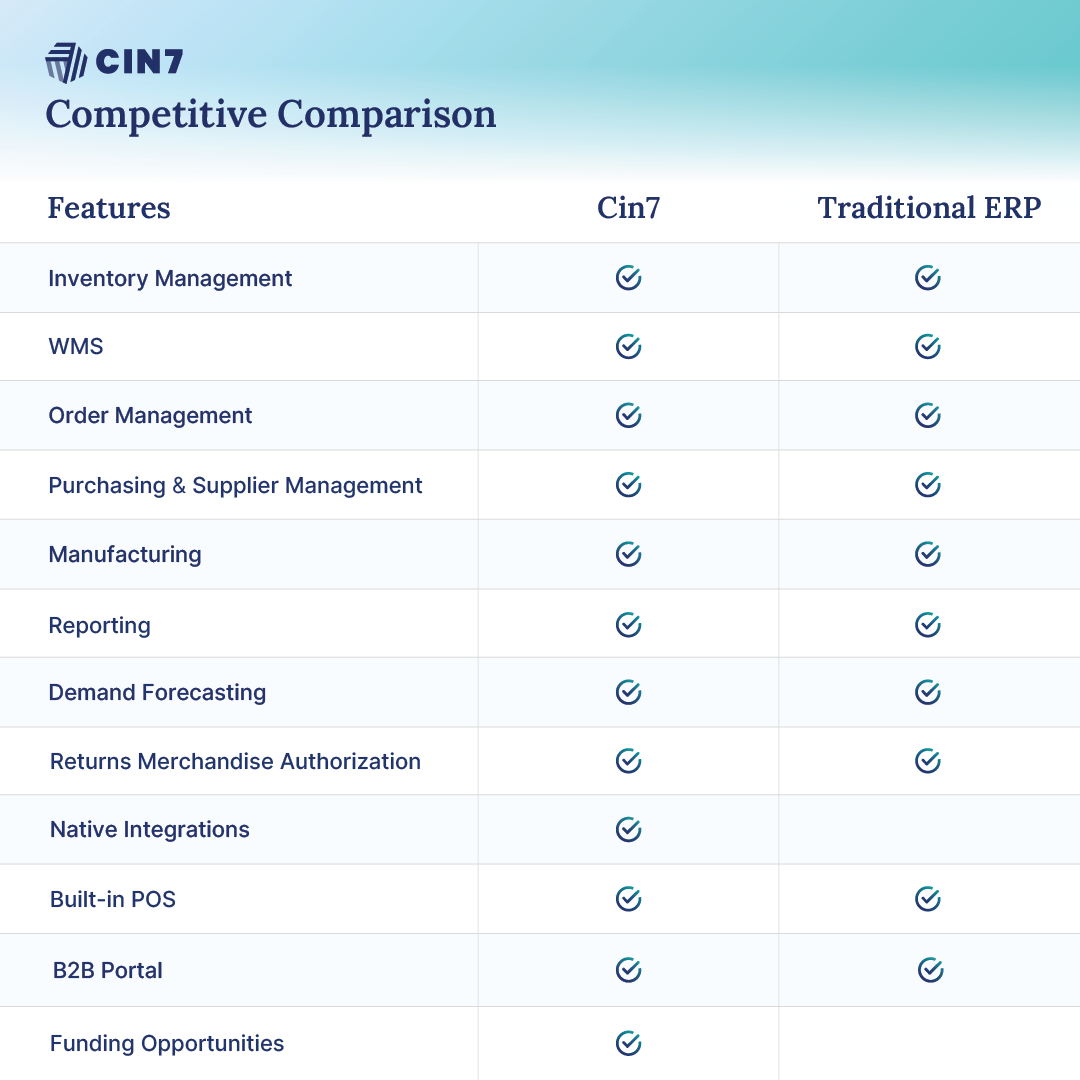
Altogether, Cin7 provides:
- Product Information Management (PIM): Centralized storage of all product information.
- Inventory Management: Pick, Pack, Ship; warehouse management (WMS); and inventory counts/stocktake.
- Order Management: Manage Sales, Transfer, and Purchase Orders.
- Purchasing and Supplier Management: AI-driven purchasing suggestions, automated reordering, and supplier performance tracking.
- Manufacturing: BOMs, work centers, quality assurance, MRP, and MPS.
- Reporting: 100+ customizable pivot table reports on inventory, cash flow, COGS, and forecasting.
- Demand Forecasting: Foresight AI for algorithmic forecasting and automatic replenishment.
- Returns Merchandise Authorization (RMA): Works for all marketplaces you sell on.
- Native integrations: Amazon, eBay, ShipStation, Avalara, 3PL, EDI, and more.
- Built-in Point of Sale (POS): Integrated inventory, omnichannel fulfillment, and unlimited outlets and registers.
- B2B Portal: Wholesale buying with catalog review, order placement, and delivery management.
And Cin7 offers Cin7 Capital, which we launched in 2024 as the first embedded lending solution in the inventory management industry. It connects product sellers and small to midsize businesses (SMBs) to vetted funding sources directly within the software, helping them drive operational growth.
How Cin7 and Traditional ERP Systems Compare
Both traditional ERPs and Cin7 equip product sellers with the tools to manage inventory and overall operations. Many ERPs now offer cloud-based deployment models, which can reduce upfront infrastructure costs.
But even with cloud ERP options in the mix, there are still meaningful differences in total cost and implementation timeframes. Let's break those down.
Cost Differences
The true cost of traditional ERP software is challenging to pin down. It can run from the hundreds of thousands to the millions, depending on the ERP vendor you choose and their specific pricing structure.
- SAP ERP: Pricing depends on business size, users, customization, deployment, and data transfer.
- Oracle NetSuite: Pricing depends on operational complexity, modules selected, and implementation partner.
- Acumatica: Based on integrated applications, resource consumption, and licensing needs.
If you choose a traditional ERP, ask about any monthly or yearly fees, implementation fees, and support fees. These may not be included in the initial cost or disclosed upfront.
For Cin7, costs are clearly broken down into two options: Core and Omni.
Cin7 Core offers Standard, Pro, and Advanced options for businesses that need out-of-the-box features for selling online and in person, advanced manufacturing capabilities, or both. Cin7 Omni is a comprehensive option for businesses requiring custom configurations or EDI and 3PL capabilities. Separate from the monthly fee for either Core or Omni are add-on applications available at an additional cost.
Implementation Timeframes
| Solution | Implementation Time |
|---|---|
| Traditional ERP | A few months to a year |
| Cin7 | A few weeks up to a couple of months |
The time difference matters, and so do the extra costs of a longer implementation. You'll pay for your old solution while implementing the new one, so factor in the costs of an extended process.
Cin7 Competitors: How Cin7 Compares to Other Inventory and ERP Software
Traditional ERPs aren't your only alternative. Plenty of Cin7 competitors promise to run your inventory, so it helps to see how they stack up. The table below compares Cin7 to six popular options, and you can dig deeper on each with our head-to-head guides.
| Solution | Best For | Category | How It Compares to Cin7 |
|---|---|---|---|
| NetSuite | Large enterprises with IT resources | Full ERP | Implementation typically runs 6 to 12+ months with consultants, versus weeks for Cin7, and pricing is per-user and module-based. |
| Fishbowl | QuickBooks-centric desktop users | On-premise inventory | Desktop-based with roughly 45 integrations and onsite servers, while Cin7 is cloud-based with 700+ integrations. |
| Katana | Small manufacturers | Manufacturing (MRP) | MRP-focused with about 27 integrations, while Cin7 adds AI forecasting and true multichannel selling. |
| Odoo | Teams wanting deep customization | Modular open-source ERP | Highly customizable but developer-heavy to set up, while Cin7 deploys fast without a technical team. |
| Brightpearl | Retailers | Retail operations platform | Retail-focused at roughly $1,000 to $1,500 per month with no built-in manufacturing, an area Cin7 covers. |
| Unleashed | Wholesale and distribution | Cloud inventory | Wholesale-focused with about 30 integrations, but forecasting and full B2B cost extra, while Cin7 includes both. |
Here's a quick read on where each tool fits:
- NetSuite: A full ERP for large enterprises. It's powerful, but rollout can take 6 to 12+ months and needs dedicated IT.
- Fishbowl: A desktop, QuickBooks-first tool. It suits simple setups, but leans on onsite servers and fewer integrations.
- Katana: An MRP built for small manufacturers. Great for shop-floor basics, lighter on forecasting and multichannel sales.
- Odoo: A modular, open-source ERP. Very flexible, but you'll likely need developers to configure and maintain it.
- Brightpearl: A retail operations platform. Strong for omnichannel retail, but it skips built-in manufacturing.
- Unleashed: A cloud inventory tool for wholesale. Solid basics, though forecasting and full B2B are paid add-ons.
On a tighter budget? Lighter tools like inFlow and Zoho Inventory can work for very small sellers, though they lack Cin7's depth. For the full lineup, see our Cin7 competitors comparison.
The common thread? Cin7 is built for growing product businesses that have outgrown spreadsheets but don't need a heavy enterprise ERP. With pricing that starts at $349 per month and 700+ integrations, you get enterprise-level features without the enterprise overhead.
When Cin7 Is Right for Your Business
So, we've seen that both ERPs and Cin7 pack a serious punch when it comes to features. Which one's right for your business? Consider these six questions:
- Are you a small or midsized product seller needing comprehensive inventory management without complexity or overpaying for unused features?
- Are you adding a second sales channel and outgrowing your manual, error-prone inventory spreadsheets?
- Are you growing from one to multiple warehouses?
- Are you wanting to switch to a 3PL?
- Are you expanding your team and want to train every employee on the same system across departments?
- Are you modernizing your tech stack while keeping QuickBooks or Xero for accounting?
If you answer "yes" to any of these questions, Cin7 is likely the better choice.
Cin7 Delivers Enterprise-Level Features Without the Enterprise Price Tag
Cin7 takes the complexity out of inventory management. As a product seller or manufacturer, you spend less time managing and more time growing. You connect everything, see everything, and scale smarter, all without the enterprise price tag.
Cin7 customer Yiddi Paplanos, owner and CEO of YP Signal, shares: "Before Cin7, I was a hot mess. We were losing money every single day. Everything was in my head and my gut."
"Now, we have everything set up. We don't have to change anything, and a lot of credit goes to the actual software."
To learn more about how Cin7 is a wise and affordable alternative to traditional ERPs, contact us for a free demo today.
Frequently Asked Questions About Cin7 and ERP Software
What Is ERP Software?
ERP stands for enterprise resource planning. It's software that connects your core business functions, like accounting, inventory, HR, and supply chain, into one system so everything talks to each other in real time.
Traditional ERPs were built for large enterprises, which means they often come with a steep price tag and a long setup process. If you're a growing product seller or manufacturer, Cin7 delivers connected visibility without enterprise complexity or cost.
What Are Some Examples of ERP Software?
Some of the most well-known traditional ERP platforms include SAP, Oracle NetSuite, and Acumatica. They're built for large, complex organizations, and priced to match.
If you're a small or mid-sized product seller or manufacturer, you don't necessarily need a full-scale ERP to get enterprise-level results.
Cin7 is an IMS covering inventory, orders, warehousing, and manufacturing. It costs far less and deploys faster than traditional ERP. You get power without overwhelm.
Is QuickBooks an ERP System?
Not quite. QuickBooks is accounting software, and a great one, but it doesn't manage inventory, orders, warehousing, or manufacturing on its own.
That's where we come in. Cin7 integrates natively with QuickBooks, so you get powerful inventory and order management alongside your existing accounting setup.
No need to rip out what's already working. Think of it as giving QuickBooks a serious upgrade without replacing it.
What Are the Main Types of ERP Systems?
ERP systems generally come in four deployment types. Cloud ERP has become especially popular for growing businesses due to its flexibility and lower upfront costs. Here are the main categories:
- Cloud ERP: Hosted online via subscription. Easy to scale, with no server maintenance.
- On-premises ERP: Installed on your own servers. More control, higher upfront costs.
- Hybrid ERP: A mix of cloud and on-premises for local data and cloud flexibility.
- Two-tier ERP: One system for headquarters, separate systems for divisions or subsidiaries.
For most growing small and mid-sized businesses, cloud-based solutions tend to be the most flexible and affordable, and they're far faster to implement than on-premises setups. That's why many SMBs choose Cin7 over traditional ERP: connected visibility without heavy infrastructure costs.
What Are Some Good Alternatives to Cin7?
Popular Cin7 alternatives include NetSuite, Fishbowl, Katana, Odoo, Brightpearl, and Unleashed. Each leans toward a specific niche, whether that's enterprise ERP, desktop QuickBooks users, or small-batch manufacturing. If you're a growing product seller who wants deep inventory, order, and manufacturing tools without enterprise overhead, we think Cin7 is tough to beat. You can weigh the full lineup on our Cin7 competitors comparison.
What's the Difference Between Cin7 Core and Cin7 Omni?
Think of them as two doors into the same house. Cin7 Core gives you out-of-the-box tools for selling online and in person, plus advanced manufacturing, and it's ideal for small to mid-sized sellers. Cin7 Omni is the more configurable option, built for businesses that need custom setups or heavy EDI and 3PL connections. Not sure which fits? We'll help you match the right plan to your operation.
Does Cin7 Integrate With Shopify and Amazon?
Yes! Cin7 connects natively with both Shopify and Amazon, so your online store and marketplace listings stay in sync without manual re-keying. That's part of our 700+ integrations, which also cover QuickBooks Online, Xero, eBay, and more. Sell across channels and let Cin7 keep your stock levels honest behind the scenes.
How Does Cin7 Compare to NetSuite?
NetSuite is a full ERP built for large enterprises, with per-user, module-based pricing and rollouts that often run 6 to 12+ months with consultants. Cin7 is an IMS, or "ERP lite." You get connected inventory, orders, warehousing, and manufacturing that goes live in weeks, and pricing starts at $349 per month. If you're a growing SMB rather than an enterprise IT team, Cin7 gives you the power without the price tag or the long wait.
What Did Cin7 Used to Be Called?
Cin7 Core was formerly known as DEAR Systems (also called DEAR Inventory) before it joined the Cin7 family and was rebranded. Cin7 Omni was originally the product simply called Cin7. Today both live under the Cin7 name, so you get the same connected inventory management with one shared identity.
More from the blog
View All Posts
Best Wholesale Inventory Software: A Buyer's Guide for 2026
Read More
What is ERP? Definition, Industry-Specific Uses & Examples
Read More