










Picture your typical Tuesday. A sale lands on your website, another on a marketplace, and a big one from a wholesale buyer. Meanwhile, your actual stock lives in a totally separate system. Sound familiar?
When your inventory and your orders live in different tools, they drift out of sync. You oversell things you don't have and sit on things nobody's buying. And the bill for that adds up fast. IHL Group projected that global retail inventory distortion, the combined cost of stockouts and overstocks, hit roughly $1.7 trillion in 2024. That splits into $1.2 trillion in out-of-stocks and $554 billion in overstocks.
If it feels like these problems multiply the moment you add a channel or a warehouse, you're right. Every new place you sell or store stock is another connection your disconnected tools have to fake. The cracks don't just add up. They compound.
Here's the good news: the fix isn't more spreadsheets or more staff. It's one system that manages inventory and orders together.
In this guide, we'll define what this kind of system actually is and explain why combined beats separate. Then we'll walk through the features that matter and help you choose the right one. Let's dig in.
What Is an Inventory and Order Management System?
Let's answer the question directly. An inventory and order management system is a single platform that tracks your stock levels and processes customer orders in one place, keeping both in sync in real time.
To understand why that matters, it helps to split it into its two halves.
Inventory management is about what you have and where it lives. Think units on the shelf, in the warehouse, or in transit between locations. Order management is about the sale itself: capturing an order, routing it to the right place, and getting it fulfilled and out the door.
So what does "combined" actually change? Everything runs on one source of truth. When an order comes in, your stock count updates automatically. And your available stock governs what you can sell, so you're never promising units you don't actually have on hand.
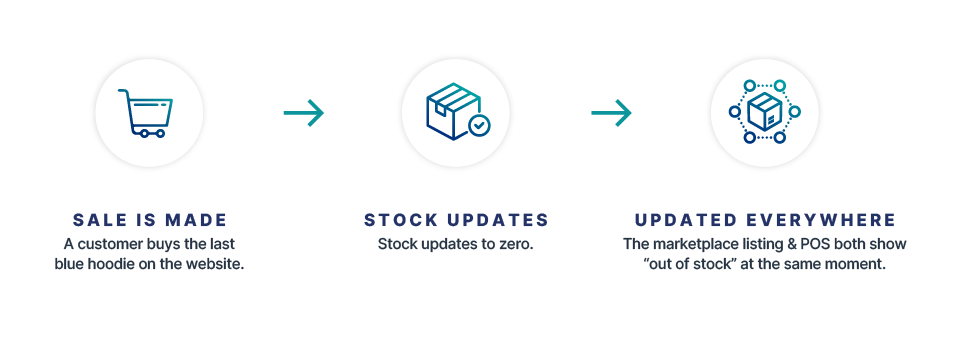
Here's a quick picture. A customer buys your last blue hoodie on your website. In a combined system, that unit instantly disappears from what's available on your marketplace listing and your POS. Nobody else can buy it, because there's nothing left to buy. That's the whole game: one sale, one update, everywhere at once.
That's exactly what an inventory management system (IMS) like Cin7 does. It connects your inventory and your orders across every channel you sell on, so the whole operation moves as one.
Inventory Management vs. Order Management: What's the Difference?
Where They Overlap and Where They Break Apart
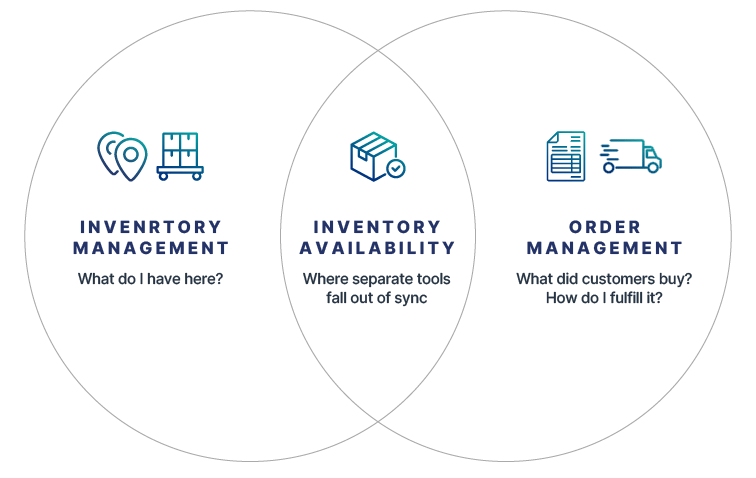
Think of it this way. Your IMS answers "what do I have, and where is it?" Your order management side answers "what did customers buy, and how do I fulfill it?" Both are essential, and most growing businesses need both working in step.
The tricky part is the overlap: inventory availability. That single point, knowing what's truly sellable right now, is exactly where separate tools fall out of sync. Your order tool thinks you have ten in stock. Your warehouse knows you have two. Somebody's about to have a bad day.
And that gap carries a real price. Auburn University RFID Lab research found that without item-level tracking, only about 69% of inbound orders are fully accurate. In fact, item-level inventory accuracy in stores typically runs just 55% to 80%, according to RFID retail expert Dean Frew writing in RFID Journal. That's a lot of guesswork baked into your day, and a lot of room for costly mistakes.
The upside of closing that gap is just as real. Item-level tracking and automation can cut out-of-stocks by up to half, according to Auburn University RFID Lab research. In other words, this isn't a rounding error you can shrug off. It's a genuine lever for growth.
When you bolt an order management tool onto a separate inventory system, you're really just syncing two databases and hoping they agree. Every lag between them has the potential to become an oversell or a stockout. It's not a question of if they'll disagree, but when. And the busier you get, the more often it happens.
So do you need one, the other, or both? For most product businesses selling across more than one channel, the honest answer is both, working as a single system. And that's especially true as more of your sales shift online. eMarketer projects US retail marketplace sales will reach about $603 billion by 2027, roughly 35% of total US retail e-commerce. More channels means more moving parts to keep in sync.
Why Combine Inventory and Order Management in One System?
The Hidden Cost of Stitching Separate Tools Together
Running separate tools comes with a fragmentation tax, and it's getting steeper. Salesforce found that new store associates now juggle an average of 16 different systems daily, up from 12 in 2023. That's a lot of tabs to keep straight, and a lot of places for your numbers to disagree with each other.
You're not imagining the problem, and you're definitely not alone in it. Salesforce also reports that 88% of retailers say unified commerce is very important or critical. Yet only 15% have fully realized its value. The need is widely recognized. The solution just hasn't reached most teams yet.
There's a money angle here too. Carrying inventory isn't free. Industry benchmarks put carrying costs at 20-30% of total inventory value each year. When your stock and order data don't line up, you either over-order and pay to hold it, or under-order and lose the sale. Neither is where you want to be.
A combined system removes the sync layer entirely. One order, one stock update, one truth. No middleman, no lag, no crossed fingers hoping two systems landed on the same number.
In plain terms, here's what that gets you:
- No more overselling stock you don't actually have on the shelf.
- Faster fulfillment, because orders route without manual handoffs.
- Accurate reporting you can genuinely trust when you make decisions.
- Less time spent reconciling numbers by hand at the end of the day.
- Room to grow your sales without having to grow your headcount.
Best of all, those "surprise inventory" moments hiding in the back of the warehouse become a thing of the past. When one system owns the whole picture, there's simply less that can slip through the cracks. Fewer surprises, more selling. That's a trade we'd take any day.
What Features Should a Combined Inventory and Order Management System Have?
The Non-Negotiables
Not every system labeled "all-in-one" earns the title. So when you're evaluating options, here's the checklist worth keeping handy.
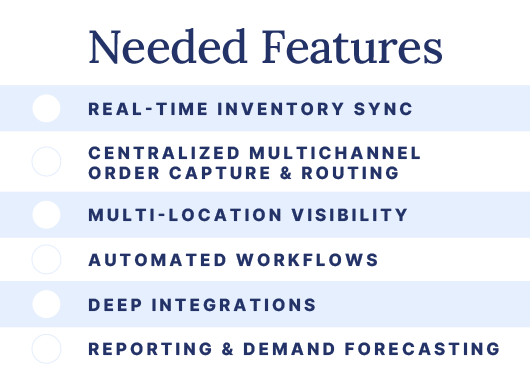
- Real-time inventory sync across every channel. As Forrester's Emily Pfeiffer put it, an OMS without near-real-time inventory availability just won't cut it anymore.
- Centralized multichannel order capture and routing. Orders from your website, marketplaces, POS, and wholesale or B2B buyers should all land in one place with multichannel order capture and routing.
- Multi-location and multi-warehouse visibility. You should see stock across every location at a glance with centralized inventory management, not warehouse by warehouse.
- Automated workflows. Reordering, purchase orders, and fulfillment routing should run on autopilot, not on your memory.
- Deep integrations. Your accounting, e-commerce, and marketplace tools should connect without a fight.
- Reporting and demand forecasting. The right system helps you see what's coming, not just what already happened.
Integrations deserve a little extra attention here, because they're where many "combined" systems quietly fall short. A system can nail real-time sync internally and still strand you if it won't talk to your accounting software or your favorite marketplace. Cin7 offers 700+ integrations, including QuickBooks, Xero, Amazon, Shopify, Walmart, and eBay. That means the tools you already rely on stay connected instead of becoming another island to manage on the side.
Forecasting matters too. AI-driven demand forecasting looks at your sales patterns and helps you predict what you'll need before you run out. Instead of reacting to stockouts after they hurt, you plan around them. This is where an IMS like Cin7 earns its keep, pairing broad integrations with smart forecasting so your data works as hard as you do.
One more thing worth flagging: how the pieces fit together. A great combined system doesn't just check these boxes in isolation. It ties them into one flow. A low-stock alert can trigger a purchase order, and a new order can route itself to the closest warehouse. That's the difference between a toolbox and an actual system.
How Do You Choose the Right Inventory and Order Management System?
Match the System to Your Business and Channels
There's no single "best" system, only the best fit for how you sell. So start with your channel mix and order volume. The more channels you run, the more you need centralized routing to keep them from tripping over each other.
Next, consider your business type. Retail, wholesale, e-commerce, and light manufacturing each lean on different features. A wholesaler cares about bulk orders and B2B pricing, while an online brand lives and dies by marketplace sync. Weigh what your day-to-day actually demands.
Then prioritize integrations with the tools you already run: your accounting software, your storefronts, your marketplaces. A system that plays nicely with your existing stack saves you a world of setup headaches down the road.
Also, leave room to scale. A system that fits you as a start-up should still serve you at enterprise volume. That way you're not shopping for a replacement in two years, just when things get busy. Switching systems mid-growth is nobody's idea of a good time, so pick one that grows with you.
It's worth being honest about complexity, too. If you assemble parts, kit products, or do light manufacturing, you'll want a system that tracks components and finished goods together. A tool built only for simple resale will leave you patching gaps by hand, which is right back where you started.
Finally, think about ROI. McKinsey found that AI-enabled inventory optimization can cut inventory 20-30% in distribution operations. In one consumer goods case, a redesigned network and fulfillment model delivered 30% fewer stockouts. Those figures are scoped to specific operations, so treat them as a directional sign rather than a promise. Still, they show the upside is real when the system genuinely fits your business.
Want to go deeper before you decide? It's worth reviewing the key questions to ask when choosing an IMS and comparing the best order management software options side by side.
Key Takeaways
Short on time? Here's the whole story in a few lines.
- A combined inventory and order management system manages stock and orders in one place, in real time.
- Separate tools create sync gaps that lead to overselling, stockouts, and manual rework.
- Real-time inventory visibility and broad integrations are the features that matter most.
- The right system fits the channels you sell on today and scales with you as you grow.
Frequently Asked Questions
Which System Combines Inventory and Orders?
An inventory management system (IMS) that includes order management combines both in one platform. Cin7 is a great example. It tracks stock and processes orders together across every channel, keeping them in sync automatically. That gives you one source of truth instead of two systems you constantly have to reconcile.
What Is the Difference Between Inventory and Order Management?
Inventory management tracks what you have and where it's stored. Order management handles capturing, routing, and fulfilling customer sales. They meet at inventory availability, which is exactly why running them in one system keeps your numbers accurate and your customers happy.
What Are the Four Stages of Order Management?
The four stages are receiving the order, processing it, fulfilling it, and handling post-sale activity like returns. A combined system moves an order through all four while updating your stock at each step, so nothing falls through the cracks.
Can One System Manage Inventory Across Multiple Channels?
Yes. A combined system captures orders from your website, marketplaces, POS, and wholesale channels, then draws from one shared pool of stock. That's what stops you from selling the same unit twice across different channels.
What Is the Role of Inventory Management in an Order Management System?
Inventory management is the backbone that tells the order side what's actually sellable. It confirms availability before an order is promised, then updates stock the moment a sale is made. Without it, order management is really just guessing.
How Cin7 Helps You Move Forward
So where does this leave you? If you've been wrestling separate tools into agreement, there's a simpler path forward.
Cin7 is an IMS that unifies inventory and order management across every channel you sell on. With 700+ integrations and AI-powered demand forecasting, we connect your stock, your sales, and your accounting so they finally speak the same language. One source of truth, no manual syncing required.
Don't just take our word for it. The Lip Bar switched from Fishbowl to Cin7 and stopped manually syncing inventory and uploading orders one by one. The result? Roughly 16 to 24 hours saved, about two to three full work days back in their week. That's time they get to spend growing the business instead of babysitting spreadsheets.
That's the whole promise of a combined system, brought to life. Less time reconciling numbers, fewer oversells, and the confidence that what you see is what you've actually got. You get to spend your energy on the fun parts of the business again.
We'd love to show you what that could look like for your team. Request a demo and see for yourself how Cin7 helps you sell more, save time, and scale smarter.
More from the blog
View All Posts
Multichannel Order Management System: The Complete Guide
Read More
The Best Inventory Software With 3PL Integrations (And How to Choose One)
Read More