








.png?width=510&height=267&name=072226_IMS3PL_BlogHeaderImage%20(1).png)
You handed fulfillment off to a third-party logistics provider to save time and headaches. Smart move!
But here's the catch: without a solid 3PL integration, your systems don't talk to your 3PL, and you've just traded one headache for another. Overselling. Stockouts. Late nights reconciling spreadsheets that never quite match. This problem is only getting more common, too.
The global 3PL market was valued at about $1.26 trillion in 2025 and is projected to reach roughly $2.5 trillion by 2033, according to Grand View Research. That means more brands than ever are handing over their warehouses, and are running into this exact sync problem. The good news? The right inventory software with 3PL integrations gives you back full visibility without adding manual work to your plate. Let's walk through what to look for, what actually syncs, how to set it up, and how to pick a system that keeps you and your 3PL on the same page.
Key Takeaways
- A 3PL integration is a direct connection between your inventory software and your 3PL's warehouse system that syncs orders, stock, and tracking automatically.
- A true 3PL integration syncs sales orders, purchase orders, inventory receipts, stock levels, and tracking, both ways.
- Your 3PL is just one piece. Storefronts, marketplaces, carriers, accounting, and EDI retail partners all plug into the same loop, with your IMS as the source of truth.
- API is the fastest connection, EDI suits legacy systems and big retailers, and middleware fills gaps but adds upkeep.
- Most product businesses need an inventory management system (IMS) that connects to their 3PL's warehouse system, not a provider-side WMS or a heavy ERP.
- Native integrations beat custom or middleware connections on cost and reliability.
- Setup comes down to six steps: pick your source of truth, confirm native support, map your data, connect your channels, test, and monitor.
- Cin7 connects to 125+ 3PLs and 700+ total integrations, keeping brands in sync as they scale.
What Is a 3PL Integration?
A 3PL integration is a connection between your inventory and order software and your 3PL's warehouse system. (Yep, that's it. The internet just loves to overcomplicate it.) When the two are linked, orders, stock counts, and shipping details move between them on their own, so nobody has to key data in by hand.
Here's where it gets a little confusing, though. There are really two sides to "3PL software." One side is the software a logistics provider uses to run their warehouse, which is a warehouse management system (WMS). The other side is the software you use as a brand that hands fulfillment to that provider, which is usually an inventory management system (IMS).
This article is about the second one, because that's where most product sellers actually sit. As logistics provider Buske Logistics frames it, a 3PL integration links your systems (your e-commerce platform, your marketplaces, your inventory or order software) to the 3PL's WMS and shipping carriers so fulfillment runs automatically from checkout to delivery. Knowing which side you're on changes what you buy, so keep it in your back pocket as we go.
What Data Actually Syncs in a 3PL Integration?
Most articles wave their hands at "syncing" and move on. We won't do that to you. A solid 3PL integration moves a full loop of information, and it's worth seeing the whole thing. Think of it as orders out, tracking in. When a customer buys, the sales order flows from your order management software to your 3PL. Once it ships, tracking details flow back so you (and your customer) know where the package is.
The same loop happens on the supply side: purchase orders go out to your 3PL, and inventory receipts come back when stock lands in their warehouse. In between, your real-time stock levels stay current across every location, so you're never guessing what's actually available to sell. Stock transfers between warehouses update automatically too, and your product catalog and SKUs push to the 3PL so their system speaks the same language as yours. That's a lot of moving parts!
When it's built right, though, 3PL inventory management software runs this entire loop in the background. No spreadsheets, no copy-paste, no "wait, which number is correct?" moments. You just get an accurate picture, all the time.
The Systems You'll Connect to Your 3PL
Your 3PL rarely works alone. Most brands connect five kinds of systems to the same integration, and each one sends or receives something different.
- E-commerce storefronts. Orders from Shopify or WooCommerce flow to your 3PL for fulfillment. Tracking flows back so your customer gets that "it shipped!" email.
- Marketplaces. Amazon, Walmart, and eBay orders route to the 3PL, while updated stock counts flow back to every listing. That's what keeps multichannel selling from turning into multichannel overselling.
- Shipping carriers. Your 3PL books the carrier and sends tracking numbers back to you. Shipping a few orders yourself? ShipStation can plug into the same flow.
- Accounting software. Shipment confirmations and inventory receipts from your 3PL become sales and cost records in Xero or QuickBooks Online. Your books stay accurate without double entry.
- EDI retail partners. Big-box retailers send purchase orders through EDI connections, which your software passes to the 3PL. Ship notices then flow back to the retailer once the order leaves the dock.
The trick is keeping one source of truth. Your IMS owns the inventory record, and your 3PL mirrors it, so every channel pulls from the same number. For a deeper look at keeping online stock accurate, check out our guide to e-commerce inventory management.
How 3PL Integrations Actually Connect (API, EDI, and Middleware)
Now that you know what data moves, let's talk about how it actually travels between systems. There are three main connection methods, and understanding them helps you pick the right approach for your setup.
- API (Application Programming Interface). This is real-time data exchange. When an order comes in or stock changes, API calls push that information instantly between your IMS and your 3PL's WMS. It's the fastest option and the standard for modern cloud software.
- EDI (Electronic Data Interchange). EDI uses structured batch files (like the 940 for warehouse shipping orders and the 945 for shipment confirmations) exchanged on a schedule. It's common with legacy systems and large retailers. If you're curious about how these transactions work, our guide to EDI breaks it all down.
- Middleware or iPaaS (Integration Platform as a Service). These are third-party connectors that sit between systems and translate data formats. They're often used when you're linking complex ERPs or juggling multiple 3PLs with different technical requirements.
Here's how the three stack up side by side.
| Method | Speed | Best for | Upkeep |
|---|---|---|---|
| API | Real time | Modern cloud software and brands that need instant stock and order updates | Low when the connector is native; higher when it's custom-built |
| EDI | Scheduled batches | Legacy systems and large retail partners that require standard documents | Moderate, since document mapping and partner testing take ongoing care |
| Middleware (iPaaS) | Varies by connector | Complex systems or several 3PLs with different technical requirements | Higher, because it's one more subscription and one more system to maintain |
When your software offers native, pre-built connectors for any of these methods, you skip the custom development and ongoing maintenance headaches. That's why native beats DIY every time.
Do You Need an IMS, a WMS, or an ERP?
Here's a question almost nobody answers for you, and it's the one that saves you the most money. Three letters get thrown around a lot, so let's sort out which system you actually need.
Inventory Management System (IMS)
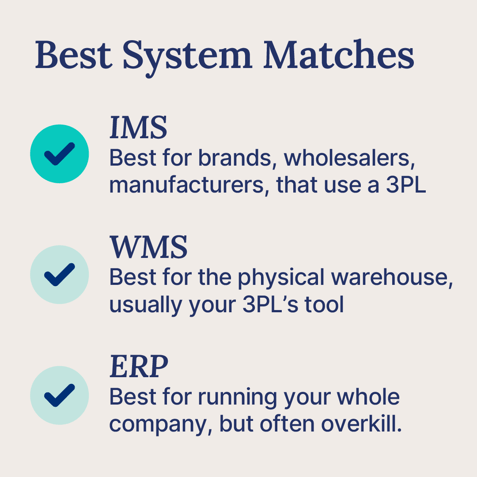
An IMS is the sweet spot for most brands, wholesalers, and manufacturers that use a 3PL. It syncs your sales channels, your stock, and your 3PL, giving you one clear view of everything. This is Cin7's category: our inventory management software is an IMS, sometimes called "ERP Lite," built for growing product businesses that need power without the weight of a full enterprise system.
Warehouse Management System (WMS)
A WMS runs the physical warehouse itself: bin locations, picking routes, packing stations, the works. Usually, this is your 3PL's tool, not yours. If you've outsourced fulfillment, you generally don't need to buy your own 3PL warehouse management software, because your provider already has one. You just need to connect to it.
Enterprise Resource Planning (ERP)
An ERP tries to run your entire company, from finance to HR to manufacturing. It's heavy, it's expensive, and for a lot of growing product businesses, it's overkill. As HashMicro points out, matching your system type to your actual complexity and location count matters, because the wrong choice wastes IT budget and causes operational disruption. For most sellers using a 3PL, the answer is an IMS that integrates cleanly, not a WMS you don't need or an ERP you'll never fully use.
Features to Look for in Inventory Software With 3PL Integrations
Ready to shop? Here's the practical checklist. Keep it handy when you're comparing options for inventory software with 3PL integrations, because these features separate the tools that actually help from the ones that just claim to.
- Native 3PL connections. Look for built-in connectors rather than third-party middleware bolted on the side. They're steadier and cheaper to run.
- Real-time, two-way sync. Data should flow both directions instantly, so orders, stock, and tracking are always current.
- Multi-3PL and multi-location support. As you grow, you'll likely add warehouses and providers. Your software should handle that without a fight.
- Multichannel connections. Shopify, Amazon, Walmart, and the rest of your sales channels need to feed into the same system.
- Accounting sync. Native links to tools like Xero and QuickBooks keep your books accurate without double entry.
- Demand forecasting and reporting. Good data helps you buy smarter and avoid both stockouts and overstock.
- Easy setup and real support. A great feature list means little if you can't get it running.
Match each of these to what a platform actually delivers, not just what its marketing page promises, and you'll separate the contenders from the pretenders quickly.
Native vs. Custom 3PL Integrations (Why It Matters)
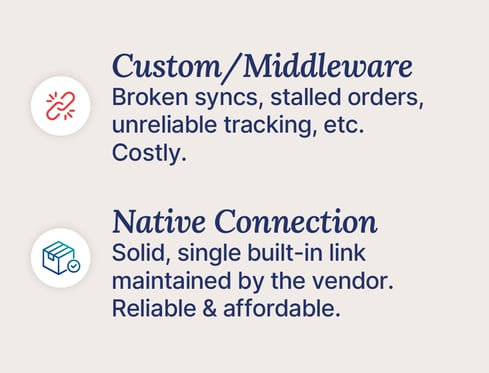
Not all connections are created equal, and this is where a lot of businesses get burned. A custom or middleware 3PL integration is essentially a one-off bridge someone builds (and rebuilds) between your systems. It works until it doesn't. These connections tend to break when either side pushes an update, they cost more to maintain over time, and they add extra failure points to a process that's supposed to run itself. Every one of those failure points is a chance for stock counts to drift, orders to stall, or tracking to go dark, and you're usually the one who finds out last.
Native connectors are a different story. They're pre-built, tested, and maintained by the vendor, so when something changes on either side, keeping the link healthy is the vendor's job, not yours. Fewer failure points means fewer surprise stockouts and a lot less firefighting on a random Tuesday afternoon.
There's a budget angle here too: custom builds often carry ongoing developer costs and separate connector subscriptions, while native links are simply part of the platform you already pay for. When you're evaluating 3PL integration software, ask a simple question: is this connection built in and maintained for me, or am I signing up to babysit it forever? Your future self will thank you for asking.
This pain multiplies when you're working with more than one 3PL. Each provider may use a different API, a different file format, or a different WMS altogether. Maintaining separate custom connections for each one means separate updates, separate troubleshooting, and separate costs. With native, pre-maintained connectors, managing inventory across multiple warehouses and 3PLs becomes one unified workflow instead of a patchwork of fragile links. Just ask Brain Dead, the LA streetwear brand that outgrew error-prone shared Excel spreadsheets on Shopify. With Cin7, it now runs four global warehouses in the US, the UK, the EU (Netherlands), and Hong Kong. Cin7 even spotlighted items its 3PLs had lost. Add local-courier fulfillment to the mix, and US shipping dropped from about $45 to $10 per order.
How Cin7 Keeps You in Sync With Your 3PLs
So what does this look like with a real platform and a real brand? Let's show you. Our 3PL Connect feature links Cin7 to 125+ 3PLs and their warehouse management systems, and it's part of the 700+ total integrations we offer. It handles that full data loop we walked through earlier: sales orders out and tracking back, purchase orders and inventory receipts, real-time stock levels, stock transfers, and your product catalog, all synced automatically with no spreadsheets in sight. It's native and built in, so there's no extra middleware to subscribe to, and our in-house 3PL specialists help set it up during onboarding. Better yet, you can run multiple 3PLs on one account, splitting fulfillment by region, channel, or product line.
That flexibility is exactly what Glorious, the gaming peripherals brand, needed. They'd outgrown their old system and wanted to fulfill orders based on where customers actually were. With Cin7, they grew their logistics operation from one to three warehouses, added a Hong Kong warehouse for global distribution, unified their inventory data, and now handle thousands of orders a day without a hitch. That's what staying in sync looks like at scale.
Frequently Asked Questions
What Is Inventory Software With 3PL Integrations?
It's an inventory management system that connects directly to your 3PL's warehouse software. Instead of manually updating stock and orders in two places, the two systems share data automatically. You get one accurate view of inventory across your channels and your 3PL.
Do I Need a WMS if I Already Use a 3PL?
Usually not. Your 3PL runs its own warehouse management system to handle picking, packing, and storage. What you need is an IMS that connects to their WMS, so your side stays in sync. Buying your own WMS on top of that is typically redundant.
What Data Syncs Between My Inventory Software and My 3PL?
A good integration syncs sales orders and shipment tracking, purchase orders and inventory receipts, real-time stock levels, stock transfers, and your product catalog. The flow runs both ways. Orders and POs go out, while tracking, receipts, and updated counts come back.
How Many 3PLs Can I Connect at Once?
That depends on your software, but the best 3PL inventory management software lets you run several at the same time. Cin7 supports multiple 3PLs on one account, so you can split fulfillment by region, channel, or product line as you grow.
How Much Does 3PL-Integrated Inventory Software Cost?
Pricing varies by platform, plan, and how many integrations or locations you need, so there's no single sticker price. One thing worth knowing: native integrations help you avoid the extra middleware and connector fees that custom setups often rack up over time.
What Does 3PL Mean in Logistics?
3PL stands for third-party logistics. It's when you outsource warehousing, fulfillment, or shipping to an outside provider instead of handling it yourself. The 3PL stores your inventory, picks and packs orders, and ships them to your customers on your behalf.
What Are the Three Types of 3PL Integration?
The three main types are API, EDI, and middleware (also called iPaaS). API connections exchange data in real time. EDI sends structured batch files on a schedule. Middleware sits between systems to translate data formats when direct connections aren't available.
What's the Difference Between an API and EDI Integration?
An API integration moves data in real time, pushing updates the moment something changes. EDI uses scheduled batch files in a standardized format, so updates happen at set intervals rather than instantly. APIs are faster; EDI is more common with legacy systems and large retailers.
How Do I Set Up a 3PL Integration?
Start by choosing inventory software that offers native connectors to your 3PL. Connect your sales channels and accounting tools, then let the software's built-in connector handle the sync with your 3PL's warehouse system. Most vendors offer onboarding support to help you get everything running smoothly.
Stay in Sync as You Scale With Cin7
Outsourcing your fulfillment should give you time back, not take your visibility away. That's the whole point. With the right IMS and native 3PL integrations, you can add partners, open new warehouses, and grow into new regions without your operations coming apart at the seams. The tools you choose today decide how smoothly you'll scale tomorrow, so it's worth getting the decision right. Brands like Glorious have done exactly that, scaling from one warehouse to several while handling thousands of daily orders without breaking a sweat. You can too. We'd love to show you how Cin7 keeps you and your 3PLs perfectly in sync, so you can sell more, stress less, and scale smarter. Request a demo and see it in action.
More from the blog
View All Posts
What is 3PL (Third-Party Logistics)? The Ultimate Guide
Read More
Multichannel Inventory Management: Complete Guide for 2026
Read More