








Best Wholesale Inventory Software: A Buyer's Guide for 2026
If you sell products in bulk, you already know that inventory is the heartbeat of your business.
Get it right and orders ship on time, customers stay happy, and cash keeps flowing. Get it wrong and you're stuck with dead stock, angry buyers, or both. That's exactly why the right wholesale inventory software has become non-negotiable for modern wholesalers and distributors.
Manual spreadsheets and gut feel simply can't keep up with today's order volumes and sales channels. The market agrees, too. The global inventory management software market is projected to reach $7.14 billion by 2033, growing at an 8.9% CAGR. In this buyer's guide, we'll walk you through what wholesale inventory management software does, the features that matter, and how to pick the right fit for your business.
Key Takeaways
- Wholesale inventory software tracks stock, orders, and fulfillment in real time so you always know what you have and where it's going.
- The must-have features are real-time tracking, multichannel integrations, and analytics with demand forecasting.
- Standalone tools are affordable but limited; a full ERP is powerful but pricey and complex for most small businesses.
- Cin7 gives you the best of both worlds: IMS depth with "ERP Lite" reach, at a fraction of the cost of a traditional ERP.
- For growing wholesalers and distributors, Cin7 pairs 700+ integrations with a B2B Portal built for the way you actually sell.
What Is Wholesale Inventory Management?
Wholesale inventory management is the process of tracking, organizing, and controlling stock as it moves from your suppliers to your business customers. It covers everything from receiving goods and storing them to picking, packing, and shipping bulk orders. Do it well and you keep the right products on hand without tying up cash in stock that just sits there.
The difference between wholesale and retail is scale and complexity. You're often managing high volumes, multiple warehouses, and B2B customers who each expect their own pricing and terms. That's where inventory management software earns its keep, giving you a single, real-time view of stock across every location and channel. In short, it's the difference between guessing and knowing.
Why Efficient Inventory Management Matters in Wholesale Distribution
Efficient inventory management isn't just an operational nicety. For wholesalers and distributors, it's the line between healthy margins and money leaking out the back door. Here's why it matters so much.
Cost Savings
Every unit you overstock ties up cash and warehouse space, and every stockout sends a customer to a competitor. The scale of that waste is staggering. Across the broader retail and distribution world, global retail loses about $1.73 trillion a year to inventory distortion, meaning out-of-stocks and overstocks, according to IHL Group.
Good wholesale inventory software helps you dodge both extremes. It flags slow movers before they become obsolete inventory and keeps your best sellers topped up, so you spend less on carrying costs and lose fewer sales. You can also learn how to prevent overstocking problems before they eat into your budget.
Improved Customer Satisfaction
Your B2B customers place big orders and expect them filled accurately and on time. When you can promise stock with confidence, you build the kind of trust that keeps buyers coming back. Real-time visibility means you'll never have to send that dreaded "sorry, we're out" email again.
Operational Efficiency
Automation takes the busywork off your team's plate. Instead of manually updating spreadsheets and rekeying orders, your staff can focus on growing the business. Automated reorder points, barcode scanning, and connected workflows mean fewer errors and faster fulfillment across the board.
Competitive Advantage
Speed and reliability win in wholesale. When you can quote accurate lead times, ship faster than the competition, and adapt to demand shifts, you become the supplier buyers trust. The right software turns your inventory data into a genuine edge, not just a record of what happened.
What Features Should You Look for in Wholesale Inventory Software?
Not all platforms are built for the demands of wholesale. As you shop around, keep an eye out for these core capabilities. They're the features that separate a tool you'll outgrow from one that scales with you.
Real-Time Tracking
You can't manage what you can't see. Real-time tracking gives you an accurate, up-to-the-minute count of stock across every warehouse and channel. That single source of truth is the foundation everything else is built on, from accurate order promising to smarter purchasing.
Integration With Your Sales Channels
Your inventory data shouldn't live on an island. Look for a wholesale inventory management system that connects to your accounting, e-commerce, and marketplace tools so everything stays in sync automatically. If you sell across several channels, strong multichannel selling support is a must.
Analytics, Reporting, and Forecasting
Great software doesn't just record the past; it helps you plan for the future. Robust reporting and analytics show you what's selling, what's stalling, and where your money is tied up. Add AI-driven demand forecasting and you can order smarter, avoid stockouts, and free up cash.
Additional Features to Consider
- Warehouse management with barcode scanning and guided picking and packing.
- Batch and serial tracking for traceability and recalls.
- Automated purchase orders and reorder points.
- Support for multiple currencies, locations, and price lists.
How Does Wholesale Inventory Software Connect Your Sales Channels and Tools?
For wholesalers, the real magic isn't any single feature. It's how well everything talks to each other. When your inventory, accounting, e-commerce, and shipping tools are disconnected, you end up rekeying data, reconciling mismatched numbers, and overselling stock you don't actually have. Integration is what turns a pile of separate apps into one smooth operation.
This is where Cin7 really shines. With 700+ integrations, you can plug into the tools you already use, including QuickBooks, Xero, Shopify, Amazon, WooCommerce, and eBay. Accounting stays reconciled, orders flow in automatically, and stock levels update everywhere at once. No more copy-paste, no more "lost in translation" moments between systems.
Wholesale operations often reach beyond your own four walls, too. Cin7 supports 3PL connections so third-party warehouses stay in sync, plus EDI for the big-box and enterprise buyers who require it. Whether you fulfill in-house or through partners, your data stays connected end to end.
Built for the Way Wholesalers Actually Sell
Selling to businesses is a different game than selling to consumers. Your buyers expect their own catalogs, negotiated pricing, and the ability to reorder without picking up the phone. Generic inventory tools rarely handle this well, which is why wholesale-specific workflows matter so much.
Cin7's B2B Portal lets your customers browse a custom catalog and place orders themselves, around the clock. You can set tiered and customer-specific price lists, so each buyer sees exactly the pricing you've agreed on. Bulk ordering, minimum order quantities, and account-based terms are all handled without manual back-and-forth.
The payoff is a self-serve buying experience that feels effortless for your customers and hands-off for your team. Instead of chasing order forms and updating spreadsheets, you let the system do the heavy lifting. It's inventory and ordering, built for how wholesale and distribution businesses really work.
Types of Wholesale Inventory Software: Standalone vs. ERP
When you start comparing options, most software falls into one of two camps. Understanding the trade-offs helps you avoid overpaying for features you'll never use, or outgrowing a tool the moment you scale.
Standalone Inventory Management Solutions
Standalone tools focus on doing one thing well: managing your inventory. They're typically affordable, quick to set up, and easy to learn. That makes them a solid starting point for smaller wholesalers who mainly need real-time tracking and basic order management.
Ideal use cases: newer or smaller operations with straightforward needs, limited budgets, and a single warehouse. The catch is that standalone tools can hit a ceiling. As you add channels, locations, and complexity, you may find yourself bolting on extra software to fill the gaps.
Enterprise Resource Planning (ERP) Tools
On the other end sits the full ERP, which ties inventory together with finance, HR, manufacturing, and more in one big system. The power is real, but so is the price tag and the complexity. Implementations can take months and demand dedicated IT resources.
Ideal use cases: large enterprises with deep pockets and complex, cross-department needs. For most small and mid-sized wholesalers, a traditional ERP is overkill. If that sounds like you, it's worth reading why you may not really need an ERP and what an ERP actually involves.
Cin7: The Best of Both Worlds
So what if you want the depth of an ERP without the eye-watering cost and complexity? That's the sweet spot Cin7 was built for. We're an inventory management system, sometimes called "ERP Lite," that delivers powerful, connected features at a fraction of the cost of a traditional ERP.
With Cin7 Core, you get real-time tracking, warehouse management, B2B selling, and 700+ integrations in one platform. It scales as you grow, so you won't outgrow it next year.
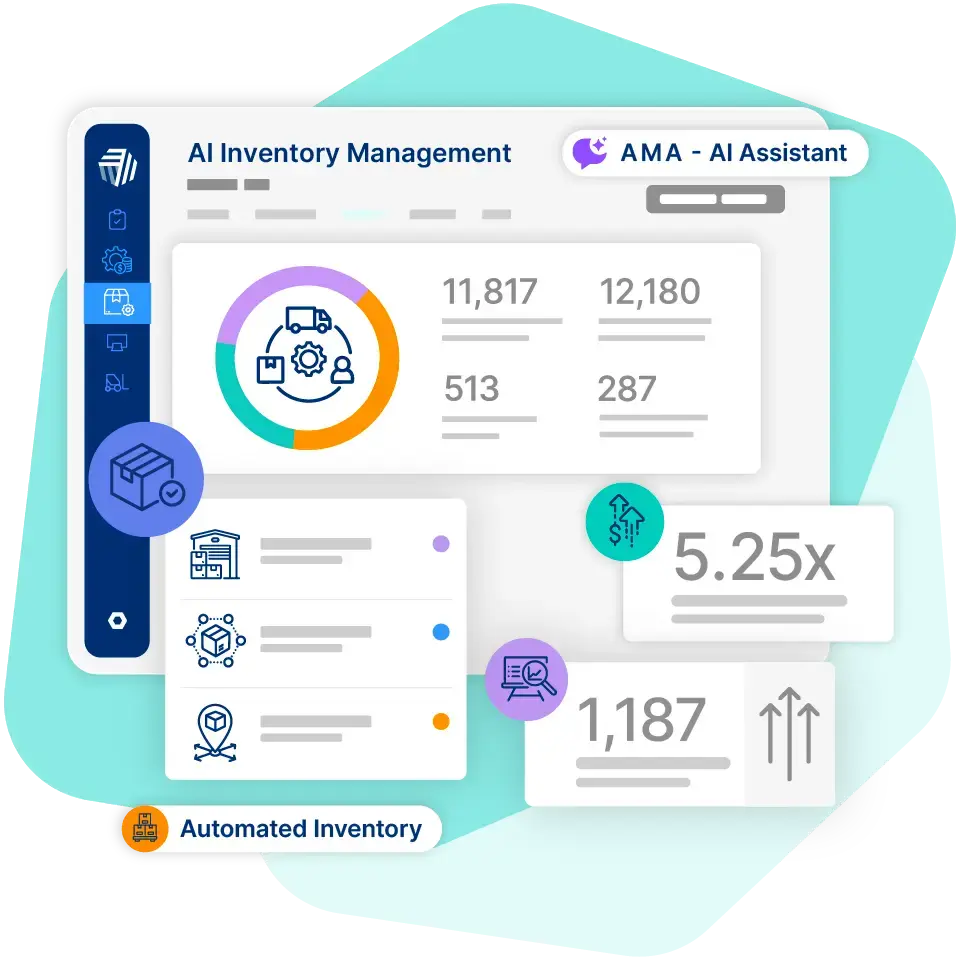
You also get AI baked in. Tools like ForesightAI forecasting and the AMA (Ask Me Anything) assistant help you make faster, smarter decisions without hiring a data team.
Take GoNano, which manufactures and distributes roof-life extension products across the U.S. and Canada. The team was running the whole operation on Excel spreadsheets, email, and Google Forms. When something went sideways, diagnosing an inventory issue could take an hour to an hour and a half.
After moving to Cin7 Core, GoNano added the AMA AI assistant and a B2B Portal for self-serve contractor ordering, plus a QuickBooks integration to kill double entry. That same inventory diagnosis now takes about 30 seconds. For COO Joel Stark's team, that's a night-and-day change in how the day runs.
The results speak for themselves. GoNano doubled its contractor network to over 400 accounts in roughly 18 months, all without proportionally adding back-office staff. That's what happens when your software grows with you instead of holding you back.
Frequently Asked Questions
What Software Is Best for Wholesale Distribution?
Honestly, it depends on your size, your sales channels, and how complex your orders get. A smaller operation with one warehouse might be fine with a simple tool, while a business juggling multiple channels needs something with more muscle. For growing wholesalers, Cin7 is a strong fit as an inventory management system (IMS), an "ERP Lite" that gives you serious depth without the weight of a full ERP.
Is There Free Wholesale Inventory Software?
Yes, free and freemium tools do exist, and they can be a fine place to start when you're just getting off the ground. The catch is that they usually cap you on channels, users, or locations, so you hit a wall right when things start going well. For a growing wholesaler, that trade-off often means paying with your time in workarounds instead of paying for software that scales with you.
How Much Does Wholesale Inventory Software Cost?
Pricing runs across a wide range. Free tools cost nothing but come with limits, standalone platforms typically charge a monthly subscription, and a full ERP can climb into the tens of thousands once you factor in setup and IT. Cin7 sits in the sweet spot, delivering ERP-style power at a fraction of the cost of a traditional ERP. You can see the details on our pricing page.
What Are the Top Wholesale Inventory Management Software Options?
The market includes plenty of solid choices, including inFlow, Zoho Inventory, Unleashed, and Cin7. The "best" one really comes down to matching the tool to your channels, order volume, and growth plans, so it pays to compare features side by side rather than chase a single winner. For a closer look, check out our roundup of the best inventory management software solutions.
Can a Small Business Use Wholesale Inventory Software?
Absolutely. Affordable cloud tools are built to scale from scrappy startups all the way up, so you don't need an enterprise budget to get real-time tracking and connected orders. Cin7 works for small and mid-sized businesses too, giving you room to grow without having to switch systems the moment you level up.
Choosing the Best Wholesale Inventory Software
There's no single "best" tool for every business, but there is a best fit for yours. Match the software to your size, sales channels, and growth plans. If you're just starting out, a standalone tool might do the trick. If you're scaling fast and juggling multiple channels, you'll want a connected platform that won't leave you stranded.
For most growing wholesalers and distributors, Cin7 hits the mark: the muscle of an ERP-style platform, the simplicity of an IMS, and a price that makes sense for small and mid-sized businesses. If you're weighing your options, our roundup of the best inventory management software for 2026 is a great next read.
Ready to see what connected inventory management can do for your wholesale business? Request a demo and we'll show you around.
Izzy Coyle
Izzy Coyle is a subject matter expert on Cin7 Core and Omni and assists in technical evaluations as a sales engineer. Before joining the Cin7 team in 2020 she was in the food & beverage and POS world, which translates into to many customer workflows she sees today. She was part of our Omni onboarding team before she...
More from the blog
View All Posts
Best Inventory Management Systems for Small Business 2026
Read More
Cin7 Core or Omni: Which One Is Right for Your Business?
Read More