








Looking for the best ERP for warehouse management? The honest answer: it depends on your size. Enterprise distribution centers usually lean toward SAP S/4HANA with Extended Warehouse Management (EWM), Microsoft Dynamics 365, or Oracle.
Mid-market firms tend to shortlist NetSuite, Acumatica, or Microsoft Dynamics 365 Business Central. And if you run one to a few warehouses? You may not need a full ERP at all, because an inventory management system (IMS) with built-in warehouse tools often fits better.
Most "best of" lists give you two choices: an ERP warehouse module or a standalone warehouse management system (WMS). We're adding the third option nobody talks about. Full disclosure: we're an IMS, and we'll tell you straight when an ERP is the right call.
Overbuying hurts as much as underbuying. Let's find your fit!
Key Takeaways
- You have three options: an ERP warehouse module, a standalone WMS, or an IMS with built-in warehouse management.
- Your size and complexity should drive the decision more than any feature count.
- ERP warehouse depth varies by tier and edition, so confirm exactly which warehouse features you're buying.
- ERP projects carry real risk, with roughly 30% running over budget in Panorama Consulting Group's 2026 survey.
- For many SMBs, an IMS with built-in warehouse tools plus your accounting software is the faster, right-sized route.
ERP vs WMS vs Inventory Management Software: What's the Difference?
An ERP runs your whole business, a WMS runs your warehouse floor, and an IMS runs your inventory, orders, and sales channels in one place. Here's how each one works.
ERP (enterprise resource planning) handles finance, HR, purchasing, and inventory in one system. The warehouse is just one module, and its depth varies by edition.
WMS (warehouse management system) runs the floor: receiving, put-away, picking, packing, and shipping. It's often bolted onto an ERP.
IMS (inventory management system) brings inventory, orders, purchasing, sales channels, and warehouse workflows together. It connects to accounting software like QuickBooks or Xero, so finance stays where it is.
That's where we live. Some folks call it "ERP Lite" or ERP for small business, and it's the middle tier most lists skip.
So, is an ERP a WMS? Partly, depending on the edition you buy. Here's the side-by-side view.
| ERP With Warehouse Module | Standalone WMS | IMS With Built-In Warehouse Tools (Like Cin7) | |
|---|---|---|---|
| Best for | Companies replacing finance, HR, and operations in one system | High-volume warehouses that need deep floor control | Product businesses that want inventory, orders, channels, and warehouse in one place |
| Typical company size | Mid-market to enterprise | Mid-market to enterprise | Small to mid-market |
| Number of warehouses | One to many, depending on edition | One to many large sites | One to several |
| Warehouse depth | Varies by edition, from basic picks to directed put-away and pick | Deepest, including labor and automation controls | Core workflows: pick, pack, put away, barcode scanning, batch and expiry tracking |
| Sales channel and omnichannel | Often needs extra connectors | Limited; relies on other systems | Built in through integrations with Shopify, Amazon, and more |
| Accounting | Included | Not included | Connects to QuickBooks or Xero |
| Typical time to go live | 9-month median | Varies widely by scope | 4-8 weeks |
| Pricing model | Licenses or subscriptions plus implementation, usually quoted | Separate subscription, usually quoted | Monthly subscription; Cin7 Core from $349 per month |
Which Option Fits Your Business? A Size-Based Guide
One to a few warehouses usually points to an IMS. Complex B2B distribution means weighing an IMS with EDI against a mid-market ERP. Enterprise distribution centers need a full ERP plus an advanced WMS.
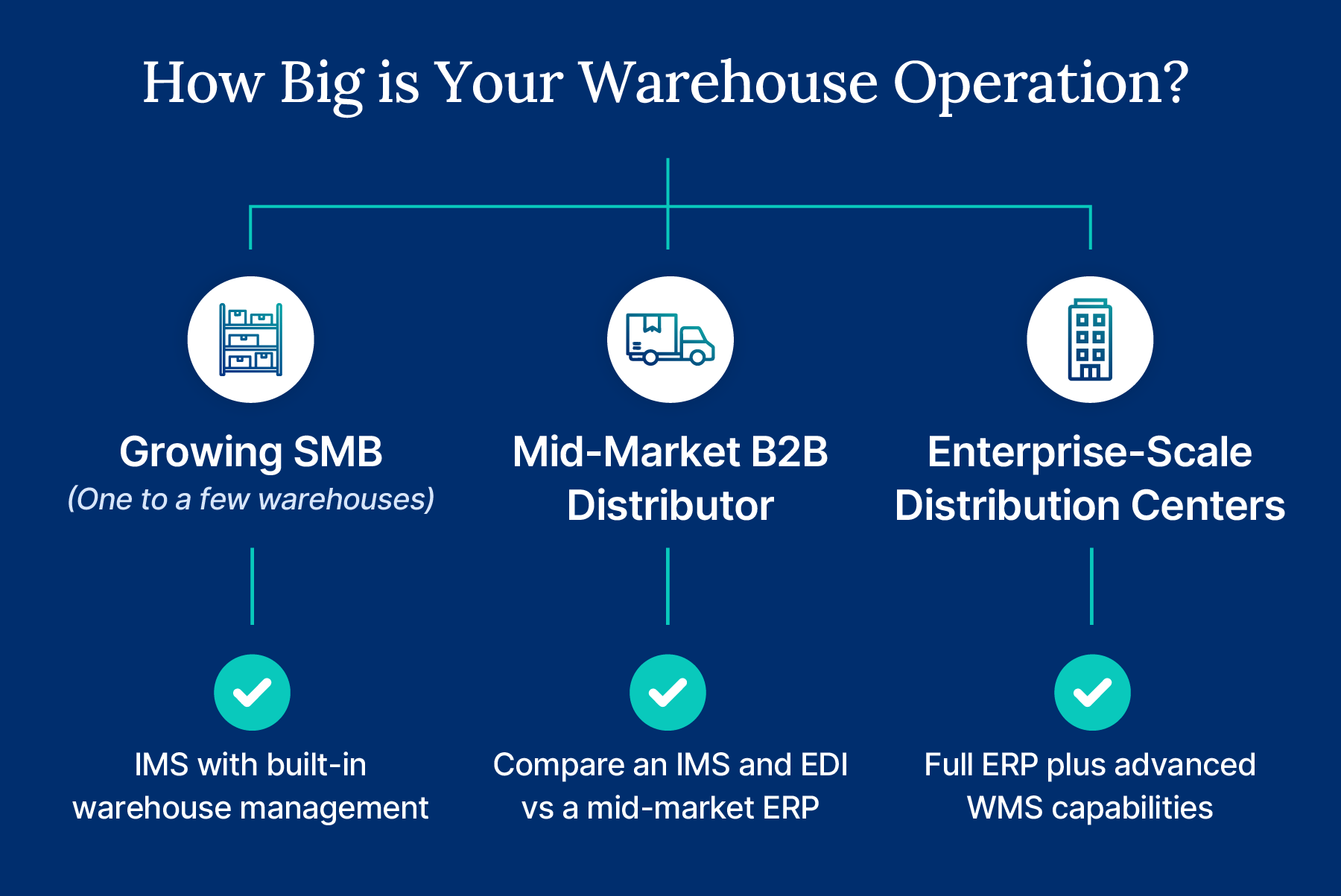
You're a Growing SMB With One to a Few Warehouses
An IMS is usually your best fit. You're outgrowing spreadsheets or basic apps, and orders are pouring in from Shopify, Amazon, and wholesale buyers. You need pick, pack, and ship workflows with barcode scanning, but you'd rather not rip out QuickBooks or Xero.
A full ERP would mean replacing your accounting just to fix your warehouse. That's a lot of surgery for a sprained ankle! An IMS keeps your books where they are and gives your team the warehouse tools they actually use.
With Cin7 Core, our Standard Warehouse Management lets your team pick, pack, restock, put away, look up stock, and scan barcodes. It supports one warehouse location.
Opening a second warehouse? Advanced Warehouse Management covers multiple warehouse locations, and it's an add-on on Pro or included on Advanced.
You're a Mid-Market Distributor With Complex B2B Needs
You should compare an IMS with EDI against a mid-market ERP. Your priorities are multi-warehouse accuracy, EDI (the electronic order format big-box retailers require), and protecting thin margins.
Panorama Consulting Group places NetSuite and Acumatica in a tier for companies with $10 million to $250 million in annual revenue.
If you also want finance, multi-entity accounting, and operations in one system, a mid-market ERP earns its spot. If your pain is mostly inventory, orders, and retailer compliance, an IMS can get you there faster. It also avoids replacing finance systems that already work.
Here's how we handle EDI: Cin7 Omni has built-in EDI connections, with pre-built links to retailers like Walmart, Target, and Costco. Cin7 Core connects through EDI partners such as SPS Commerce, Crstl, and Surpass Solutions. Either way, you can keep those retailer chargebacks at bay.
You're Running Enterprise-Scale Distribution Centers
You need a full ERP plus an advanced WMS. Think multiple large distribution centers, conveyors and robots, labor management, and 3PL billing.
At this scale, warehouse depth is the whole game. Small gains in pick speed or accuracy add up across millions of orders.
Your shortlist likely includes SAP EWM in advanced mode, Microsoft Dynamics 365 Supply Chain Management, Oracle, and Infor. SAP's advanced mode adds material flow control, yard and labor management, kitting, and cross-docking.
Is that us? Nope, and that's OK! We'd rather point you to the right tool than sell you the wrong one.
The Best ERP and Warehouse Management Options, by Business Size
The best ERP for warehouse management is the one sized to your operation. Here's a short, honest shortlist, ordered from largest operations to smallest. Read each "best for" line first, then dig into the ones that match you.
SAP S/4HANA with EWM is best for enterprise distribution centers. SAP deploys EWM with S/4HANA in basic or advanced modes, or as a standalone solution. Basic covers inventory, inbound and outbound processing, goods movement, and reporting, while advanced adds automation and labor controls.
It's powerful, and it's built for teams with big budgets and dedicated IT support.
Microsoft Dynamics 365 Supply Chain Management is best for upper mid-market and enterprise operations. Panorama places it in the $250 million to $750 million revenue tier. It's the step up when Business Central's warehouse features no longer stretch far enough.
Oracle NetSuite is best for mid-market companies that want finance and operations on one cloud platform. Panorama lists it in the $10 million to $250 million tier. Pricing is quote-based, so plan for a sales conversation.
Warehouse depth depends on the edition and add-ons you pick, so ask exactly what's included.
Acumatica is best for mid-market companies with lots of users. It prices on consumption and resources rather than per user, and it sells through partners. You won't find list prices, so request quotes early.
Unlimited users can be handy if your warehouse crew is large.
Microsoft Dynamics 365 Business Central is best for SMB and mid-market companies that want a full ERP.
Its warehouse features stack in levels. They start with basic put-away and pick and go up to directed put-away and pick with bins, zones, and FEFO (first expired, first out).
According to Microsoft partners, U.S. list pricing has been $80 per user per month for Essentials and $110 for Premium since November 2025. Microsoft's own advice is to choose options that improve your processes "without causing overhead."
Cin7 is best for SMB and growing mid-market product businesses. We're not an ERP; we're an IMS with built-in warehouse management and over 700 integrations, including QuickBooks, Xero, Shopify, and Amazon.
Cin7 Core starts at $349 per month (USD, new customers, excluding tax), and Cin7 Omni is quote-based. Every plan includes unlimited inventory locations, and more than 8,500 businesses use Cin7.
Notice a pattern? Every big vendor splits warehouse features by complexity.
So the real question isn't "ERP or WMS?" It's "How much warehouse do I actually need?"
How to Evaluate Warehouse Management in Any System
Test every system against your real workflows, then measure the results. Take this checklist into your demos and score each system honestly.
- Warehouse workflows: Check receiving, put-away, pick, pack, ship, and barcode scanning.
- Batch and expiry tracking: Confirm FIFO (first in, first out) or FEFO enforcement if you sell food, cosmetics, or anything perishable.
- Multi-warehouse visibility: See stock across every site and route each order to the nearest warehouse that has it.
- Sales channel integrations: Connect Shopify, Amazon, and your wholesale or B2B channel without manual imports.
- Accounting connection: Sync cleanly with QuickBooks, Xero, or your ERP's finance module.
- EDI support: Meet retailer compliance, either natively or through EDI partners.
- Forecasting and replenishment: Spot reorder points early so you don't run out of bestsellers.
Next, track the metrics that matter. Start with pick accuracy and inventory count accuracy. Measure your own accuracy before and after go-live so you know the system is pulling its weight.
Finally, bring your messiest real orders to every demo. Panorama Consulting Group warns that unexpected technology needs "are often a result of poor system selection."
In other words, misfits often surface late in a project. A canned demo hides them, and your real data reveals them before you sign.
How do we stack up? Cin7 includes barcode scanning, guided pick paths, smart order routing, and batch and expiry tracking. Multi-warehouse Advanced Warehouse Management is included on our Advanced plan or available as an add-on on Pro.
What ERP Implementation Really Costs (in Time and Money)
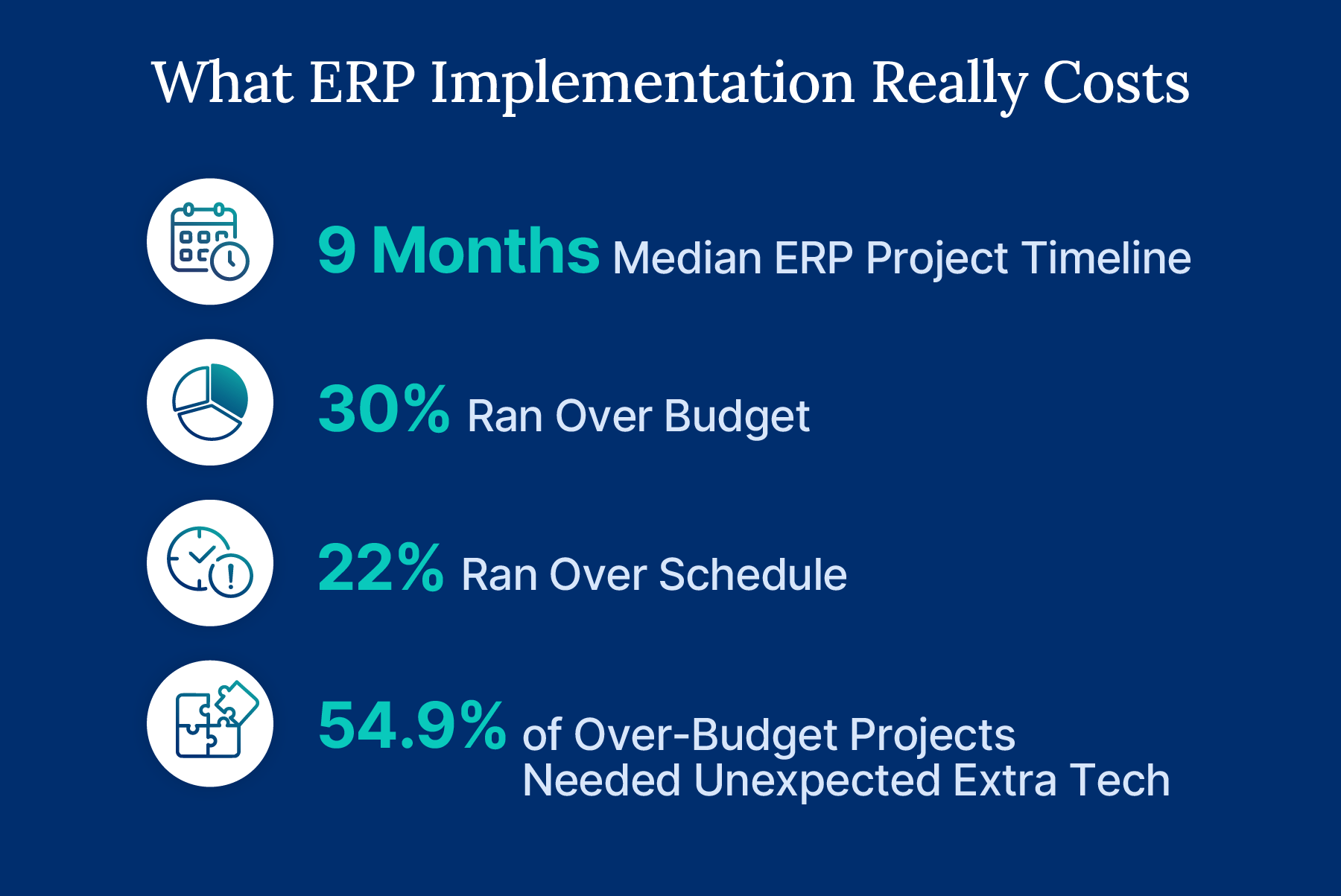
ERP projects take months and often overrun. Panorama Consulting Group's 2026 ERP Report, which surveyed 170 organizations, found a median project timeline of nine months.
Keep the sample in mind, though. The median respondent had $200.5 million in annual revenue, so this isn't an SMB benchmark. Even so, roughly 30% of projects ran over budget and about 22% ran over schedule.
Why do projects overrun? Among over-budget projects, the top reason (54.9%) was an unexpected need for additional technology.
Now for the contrast. An IMS runs on a monthly subscription: Cin7 Core costs $349, $599, or $1,199 per month for Standard, Pro, and Advanced. Go-lives can be measured in weeks, too.
To be fair, that isn't an apples-to-apples comparison. An ERP replaces your finance and HR systems, while an IMS connects to the accounting software you already have.
If you don't need that wider scope, though, why pay for it?
Real-World Example: Swapping SAP for Cin7 in 14 Days
You can swap an oversized ERP for a right-sized IMS in weeks. Oji Foodservice Packaging Solutions did it in 14 days.
Oji is a B2B distributor in Australia and New Zealand. When it became independent in December 2025, it inherited SAP from its former parent company.
"We were getting these really big invoices for SAP," the team shared in our case study. Working with implementation partner CNZ Consultants, Oji went live on Cin7 just 14 days later.
The payoff came fast. Running a batch check went from upwards of an hour to one or two minutes.
Setting up a new customer now takes only minutes. For a lean team, that's time back for customers instead of system admin.
Oji isn't alone. At Haute Diggity Dog, a Chicago-based pet toy brand on Cin7 Core, warehouse automations cut manual management work by 30%. That's a lot less ruff work for the warehouse team!
Frequently Asked Questions
Which ERP Is Best for Warehouse Management?
It depends on your size. Enterprise distribution centers usually choose SAP S/4HANA with EWM, Dynamics 365 Supply Chain Management, Oracle, or Infor. Mid-market firms often look at NetSuite, Acumatica, or Business Central, and many SMBs are better served by an IMS (see our size-based guide above).
Do I Need a Standalone WMS, or Is My ERP's Warehouse Module Enough?
Your ERP's module is often enough if your edition includes the warehouse depth you need. Check whether it supports directed put-away and pick, multiple sites, and batch tracking. If you run conveyors, robots, or labor management, a standalone or advanced WMS usually pays off.
What Is the Best Warehouse Management Software for a Small Business?
For most small businesses, an inventory management system with built-in warehouse tools is the best fit. You get pick, pack, ship, and barcode scanning while keeping QuickBooks or Xero. Use our evaluation checklist above to test options against your real orders.
Is Cin7 an ERP?
No, Cin7 is an inventory management system (IMS). You may hear it called "ERP Lite" or ERP for small business, because we handle inventory, orders, purchasing, sales channels, and warehouse workflows. Finance stays in your accounting software, which we connect to.
How Long Does It Take to Implement Warehouse Management Software?
It ranges from weeks to over a year, depending on the system and scope. Panorama's 2026 survey found a nine-month median for ERP projects at mid-market and larger firms. An IMS can go live much faster, like Oji's 14-day switch from SAP.
Find the Right Fit for Your Warehouse With Cin7
Choose for fit, not feature count. The right system matches your warehouses, channels, and growth plans today, with room to scale tomorrow. Bigger isn't always better, and the wrong system costs you months.
If you're an SMB or growing mid-market business, we've built Cin7 for you. We're an IMS with built-in warehouse management and over 700 integrations, so your channels, warehouse, and accounting stay in sync.
You keep QuickBooks or Xero, and your team gets warehouse tools they'll actually use. Want sharper reorder decisions? Add ForesightAI forecasting to any plan.
Haute Diggity Dog's warehouse automations gave its ops manager back most of her day. In the brand's words, Cin7 "basically allowed us an entire new employee."
Ready to see what right-sized warehouse management looks like? Get a demo.
More from the blog
View All Posts
ERP for E-Commerce: Why ERP Lite Is the Smarter Path to Growth
Read More
The ROI of Using an ERP System for Accounting: What You Need to Know
Read More