









A SKU (stock keeping unit) is a unique code you assign to each product variant so you can identify and track it across your business. Say it out loud and it sounds like "skew."
If you've ever sold a product, you've bumped into SKUs, whether you knew it or not. They're the quiet workhorses behind every stockroom, packing slip, and inventory report. And when they're set up well, they save you a world of headaches.
In this guide, we'll walk through what a SKU looks like, how it's different from a barcode or a UPC, how to build your own, and how SKUs behave once you're selling in more than one place.
Key Takeaways
- A SKU (stock keeping unit, pronounced "skew") is a unique internal code you assign to each product variant so you can track it.
- You create SKUs yourself, and they're not standardized, unlike a UPC, which GS1 issues as a 12-digit code used the same way everywhere.
- A good SKU is short (usually 8 to 12 characters), alphanumeric, and meaningful at a glance.
- SKUs power inventory accuracy, faster fulfillment, and demand forecasting across every sales channel.
What Is a Stock Keeping Unit (SKU)?
SKU stands for "stock keeping unit," and yes, it's pronounced "skew." It's a unique alphanumeric code a business assigns to a specific product variant so it can identify and track that item.
Here's the part that trips people up: SKUs are internal and self-created. There's no central authority handing them out. Every business defines its own format, so your SKU for a navy medium hoodie won't match the one your supplier or another retailer uses. That's completely normal.
What makes a SKU useful is that it captures the attributes that set one variant apart from another: size, color, material, packaging, and anything else you need to tell your products apart. One style of shirt in three colors and four sizes? That's twelve variants, and twelve SKUs.
You'll also hear "SKU" used in software and SaaS to describe a purchasable version of a product, but the core idea is the same: one code, one distinct thing you sell.
What Does a SKU Look Like? (A Real Example)
Let's decode a real one. Say you sell apparel and you've built this SKU:
TSH-NVY-L
Break it into segments and it practically reads itself:
- TSH = T-shirt (the category)
- NVY = Navy (the color)
- L = Large (the size)
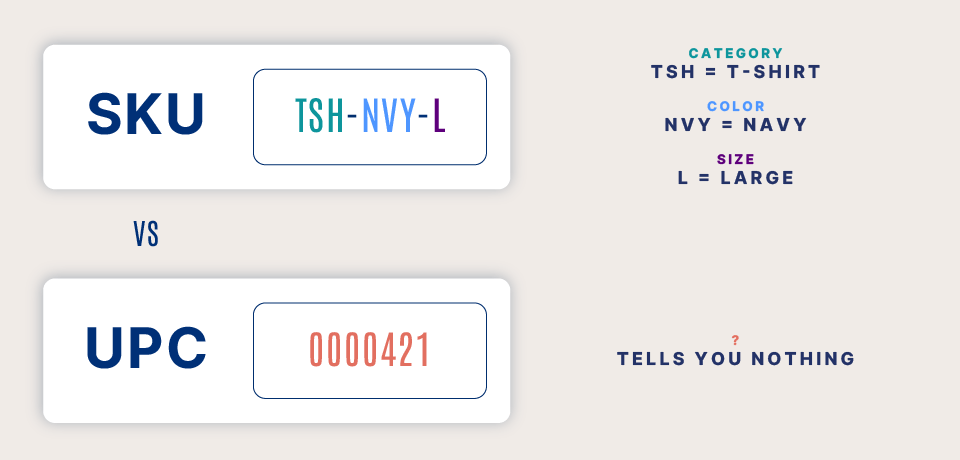
Each segment encodes an attribute, so the whole code tells a story. That's the point of a well-built SKU. It's human-readable. A picker in your warehouse can glance at TSH-NVY-L and know exactly what to grab, no lookup table required. Multiply that across hundreds of orders a day and those saved seconds add up fast.
Now compare that to a SKU like 0000421. It's technically unique, sure, but it tells you nothing. Is it a t-shirt? A tent? A tub of protein powder? Your team has no way to know without checking a separate system, which slows everyone down and invites mistakes.
Meaningful beats mysterious every time. A SKU like TSH-NVY-L does double duty: it identifies the product and describes it, all in a handful of characters. That readability is exactly what a good inventory system relies on to keep your counts straight.
SKU vs. UPC, Barcode, GTIN, and Serial Number
This is where a lot of confusion lives, so let's clear it up. These terms get used interchangeably, but they each mean something specific.
| Identifier | What It Is | Who Creates It | Scope |
|---|---|---|---|
| SKU | Your internal code for a product variant | You (self-created) | Your business only, not standardized |
| UPC | A 12-digit code issued through GS1 | GS1 (the standards body) | The same everywhere the product is sold |
| GTIN | The umbrella family of global standardized numbers | GS1 | Global; UPC and EAN are types of GTIN |
| Barcode | The scannable image that encodes a code | You or your systems | A representation, not the code itself |
| Serial Number | An ID for one individual unit | Manufacturer or you | A single physical item |
A few things worth spelling out. A UPC is standardized, so it looks and behaves the same no matter who's selling the product. A GTIN is the broader family those standardized numbers belong to, and UPC and EAN codes are both types of GTIN.
A barcode is often mistaken for the code itself, but it's really just the striped (or square) image that can encode a SKU or a UPC. It's the messenger, not the message.
And a serial number? That points to one individual unit, handy for warranties and returns, while a SKU covers every unit of a given variant.
The easiest way to remember all this: your SKU is for you. UPCs and GTINs are for the world.
Why SKUs Matter for Your Business
You can't manage what you can't identify. SKUs give you inventory visibility and accuracy at the variant level, which is the foundation everything else is built on.
And the stakes are real. Globally, retailers lose an estimated $1.7 trillion a year to inventory distortion, the combination of stockouts and overstocks that eats into revenue and ties up cash. On top of that, research finds over 60% of inventory records contain inaccuracies. That's not a rounding error, that's a serious drag on your business.
Clean SKUs help on the ground, too. When every variant has a clear, unique code, fulfillment gets faster and more accurate, because your team is picking the right item the first time instead of squinting at a shelf. Fewer picking errors, fewer angry emails.
They also make your reporting smarter. With SKU-level data, you can see which specific variants are selling, spot trends early, and forecast demand instead of guessing.
Here's the context that makes it urgent: US e-commerce topped $1.23 trillion in 2025, and most sellers are juggling several channels at once. When you're selling in multiple places, SKU accuracy isn't a nice-to-have. It's make-or-break.
How to Create a SKU (Step by Step)
Building your own SKU system is easier than it sounds. Here's a simple approach.
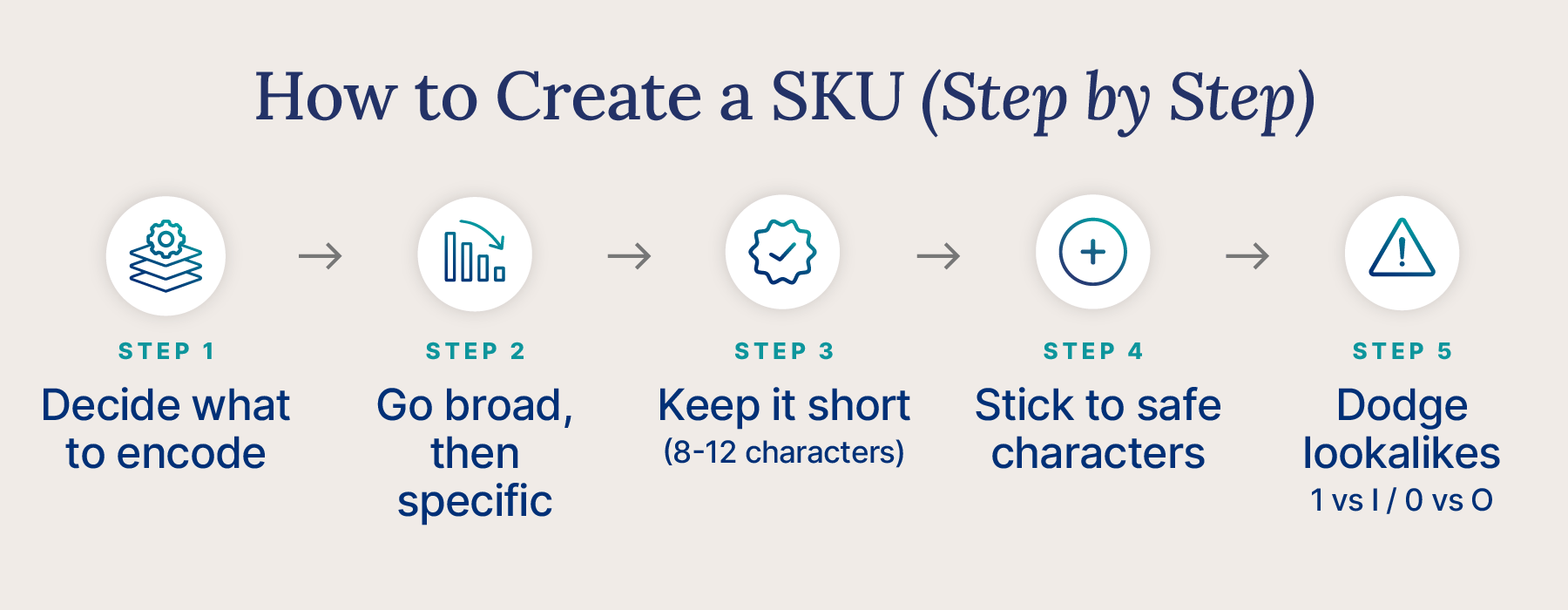
Step 1: Decide what to encode. Pick the attributes that actually matter for telling your products apart, such as category, brand, size, color, and location. You don't need every detail, just the ones that help.
Step 2: Go broad, then specific. Start with the widest attribute (category) and work toward the narrowest (size or color). Keep the attribute order consistent across every SKU so the pattern is predictable.
Step 3: Keep it short. Aim for roughly 8 to 12 characters. There's no universal maximum, but platforms vary, so shorter is safer and easier to read.
Step 4: Stick to safe characters. Use uppercase letters, numbers, and dashes or underscores. Skip spaces and special characters, which can break in spreadsheets and some systems.
Step 5: Dodge the lookalikes. Avoid characters that are easy to mix up, like the letter O versus the number 0, or the letter I versus the number 1. Your future self will thank you.
Once you've got a formula, build a template and test it across a handful of products before rolling it out. And keep your SKUs consistent across every marketplace you sell on, so your data stays clean no matter where the sale happens.
Common SKU Mistakes to Avoid
Even good systems get tripped up. Watch out for these.
- Reusing a retired SKU. When a product goes away, archive its SKU, don't recycle it. Reusing an old code corrupts your historical data and muddies your reporting.
- Starting with a 0. Some systems quietly drop a leading zero, so 0421 becomes 421. Skip the leading zero entirely.
- Building something that can't scale. A format that works for 100 products can fall apart at 10,000. Plan for the catalog you'll have, not just the one you have now.
- Inconsistent abbreviations. If navy is BLU in one SKU and BL in another, you've created chaos. Pick one abbreviation per attribute and stick to it.
SKUs at Scale: Keeping Them Accurate Across Every Channel
A SKU is only as useful as the system syncing it. On a spreadsheet, one SKU selling on Shopify, Amazon, and in your physical store can quietly oversell, because nothing is updating those counts in real time. You sell the last one three times, and now you've got two disappointed customers and some awkward apology emails.
Real-time, connected inventory fixes that by keeping one SKU accurate everywhere you sell. When a unit moves in one channel, every other channel knows about it instantly.
As your catalog grows, SKU proliferation tends to creep in, and you end up with more codes than you can reasonably manage. That's where SKU rationalization comes in, trimming and organizing your SKUs so the useful ones stand out. Clean SKU-level data also feeds AI demand forecasting, so you reorder the right variants in the right quantities instead of playing guessing games.
This is exactly what we do. Cin7 is an inventory management software (IMS) with 700+ integrations, including Shopify, Amazon, Walmart, QuickBooks, and Xero, that syncs your SKUs across channels in real time and powers AI-driven demand forecasting.
Take Forward Furniture, a Canadian retailer selling across three showrooms, an e-commerce store, and several 3PLs. On spreadsheets, they kept running out of items they thought were in stock, reordering products they already had, and believing products were on order when they weren't, which led to cancelled orders and rough reviews. With Cin7, they gained real-time visibility across every location and eliminated those stockouts and understocking. As they put it, they now avoid multi-month gaps in bestselling products that "can cost tens of thousands or more in lost revenue."
Frequently Asked Questions
What Does SKU Stand For?
SKU stands for stock keeping unit. It's pronounced "skew."
What Is an Example of a SKU?
A coffee mug in blue at 12 ounces might be MUG-BLU-12OZ. Each segment points to an attribute, so the code describes the product at a glance.
What's the Difference Between a SKU and a Barcode?
A SKU is your internal code for a product variant. A barcode is the scannable image, which can encode a SKU or a UPC. One is the information, the other is how it's read.
Can Two Products Have the Same SKU?
No. Each SKU must be unique within your system. If two variants share a code, you lose the ability to track them apart.
How Long Should a SKU Be?
Usually 8 to 12 characters is the sweet spot. There's no universal maximum, but shorter codes are easier to read and less likely to cause problems across platforms.
What Does SKU Mean in Retail?
In retail, a SKU is the unique identifier for each distinct product variant a store stocks, tracks, and sells.
Keep Your SKUs Accurate Everywhere You Sell
Once your SKUs are clean and consistent, a connected inventory system keeps them accurate across every channel, automatically. Want to see how that works for your business? Request a demo and we'll show you.