








Today's top e-commerce technology trends aren't just about increasing sales. They're about creating smarter, more seamless experiences for your customers. Think AI-powered shopping assistants, mobile commerce, supply chain automation, and immersive tech like VR and AR.
If you'd told someone 30 years ago they could buy nearly anything by tapping a couple of buttons on their phone, they probably wouldn't have believed you.
But here we are! E-commerce technology has fundamentally shifted the way we all shop and sell. Consumers have more choices than ever, with the total value of e-commerce sales in the U.S. expected to reach $1.72 trillion by 2027. And with AI reshaping how people discover and buy products, the landscape is evolving faster than ever.
In such a competitive space, whether you're an established brand or just getting started, staying on top of trends isn't optional. Here are the technology and e-commerce trends you should pay attention to this year, plus how to decide which ones will actually benefit your business.
Key Takeaways
- Mobile-First Strategy: Optimizing for m-commerce is essential as most consumers now shop via smart devices.
- AI Integration: Use AI for personalized shopping experiences, automated chatbots, and smart warehouse management.
- Operational Efficiency: Implement SCM technology and EDI to streamline supply chains and automate business communications.
- Immersive Tech: AR and VR can increase purchase intent by up to 53% by providing interactive product previews.
- Security & Trust: Prioritize blockchain and robust data privacy measures to build long-term customer loyalty.
1. Mobile Commerce (m-commerce)
M-commerce, shopping via smartphones and tablets, isn't just a niche anymore. It's how the majority of online shoppers prefer to buy. If your mobile experience isn't up to par, you're likely losing sales to competitors who've nailed theirs.
The key? Optimize your mobile user experience (UX). That means fast load times, intuitive navigation, and a checkout process that doesn't make people want to throw their phone across the room. If you don't have a mobile-friendly version of your site, or worse, no mobile experience at all, that's the first thing to fix.
Whether you're a big brand or a small shop, mobile apps can also give your customers a smoother, more engaging experience. Think push notifications for restocks, easy reordering, and personalized product recommendations all right in their pocket.
2. Supply Chain Management
If you're selling online, your supply chain isn't just a behind-the-scenes operation, it's the backbone of your customer experience. E-commerce has made the role of supply chain management technology even more critical as business models grow more complex across B2B, B2C, C2C, and even C2B.
In recent years, supply chain disruptions have been a wake-up call for businesses of all sizes. Delivery delays, rising shipping costs, and unpredictable demand have pushed brands to invest in smarter, more resilient supply chain tools. Today, AI-powered forecasting and automation are helping businesses anticipate disruptions before they snowball into bigger problems.
Other SCM-related technologies worth keeping on your radar include:
- Manufacturing automation and blockchain for transparency
- Integrated technologies in the form of a cloud-native warehouse management system
- Third- and fourth-party logistics providers (3PL and 4PL) that let you scale fulfillment without building everything yourself
3. Artificial Intelligence
Artificial intelligence (AI) is everywhere, and e-commerce is no exception as sellers strive to power their supply chains and give their shoppers personalized experiences. But in 2026, AI's role in e-commerce goes way beyond basic personalization.
One of the biggest shifts? Agentic commerce. Companies like Anthropic, OpenAI, and Google are building AI agents that can browse products, compare options, and even make purchases on a customer's behalf. This means your product data and content need to be optimized not just for human shoppers, but for AI systems too.
AI is also transforming how businesses operate behind the scenes. From AI-driven demand forecasting that helps you stock the right products at the right time, to smart warehouses that automate storage and fulfillment, there's hardly an area of e-commerce that AI isn't touching. If you're not exploring how AI can work for your business, you're likely falling behind competitors who are.
4. Chatbots and Live Chat
AI-powered chatbots have come a long way. Today's conversational AI doesn't just answer FAQs. It can recommend products based on a customer's browsing history, help compare options, process returns, and even guide someone through checkout. For your e-commerce business, that means offering 24/7 support without needing a massive customer service team.
Chatbots are also a powerful sales tool. By engaging visitors in real-time conversations, they can help move potential customers through your sales funnel. This is known as conversational commerce, and it's becoming a must-have rather than a nice-to-have.
Of course, there are times when a human touch matters. That's where live chat comes in. Customers can speak directly with a representative over chat, getting answers without needing to call or send an email. The takeaway? If you're not offering some form of instant, on-site support, whether AI-driven or human, you risk losing customers to competitors who do.
5. Augmented Reality (AR) and Virtual Reality (VR)
Want to let your customers try before they buy without them ever stepping into a store? That's the power of augmented and virtual reality in e-commerce. From virtually trying on outfits to testing furniture placement in a living room, AR and VR open up possibilities that simply weren't available a few years ago.
Here's the quick breakdown:
- Augmented reality adds virtual elements to a live view, like using your phone's camera to see how a couch looks in your actual living room.
- Virtual reality puts you in a completely simulated environment, think virtual property tours or immersive brand showrooms.
Now, AR and VR won't be the right fit for every brand. But if your products benefit from a “see it to believe it” experience, they're worth exploring. Not only do they improve UX, but research also shows that the use of VR and AR increases purchase intent by as much as 53%. That's a pretty compelling reason to take a closer look!


6. Electronic Data Interchange (EDI)
Electronic data interchange (EDI) is technology that allows e-commerce businesses to exchange information that was historically shared on paper.
For example, e-commerce shoppers and merchants can automatically place orders, generate invoices, and track the entire shipping process.
EDI streamlines online shopping by ensuring smooth communication between businesses, leading to a stress-free experience for shoppers when ordering and receiving goods.
7. Electronic Funds Transfer (EFT)
EFT technology has seen recent improvements, such as encryption-like technologies that enhance its security. EFTs have reduced our over-reliance on physical banks.
Common e-payment options include:
- Direct debit
- Withdrawals and deposits
- E-bill payments
- Instant payments
These technologies determine concurrent financial activities and reduce reliance on physical banks.
With the popularity of apps such as Cash App, Venmo, and Zelle, consumers appreciate the convenience of EFTs, making this e-commerce technology a valuable consideration for any business, especially startups.
8. Blockchain
There's a lot of controversy around blockchain technology and cryptocurrencies and that hasn't fully settled. But blockchain does offer some genuinely useful features for e-commerce, particularly around transparency and security.
At its core, blockchain provides a distributed ledger for digital transactions, which makes it attractive for verifying payments and tracking goods through the supply chain. For businesses looking to build trust with customers, that transparency can be a real differentiator.
That said, it's worth being realistic. Blockchain isn't going to replace your entire payments infrastructure overnight. But as the technology matures alongside AI, it has the potential to transform how small businesses handle everything from payments to product authentication. Keep it on your radar, but don't feel pressured to go all-in just yet.
9. Data Privacy and Security
Building trust is essential for e-commerce businesses, and in 2026, that trust starts with how you handle customer data. Investing in data privacy and security shows your customers you take their information seriously — and keeps them confident and loyal.
As AI becomes more embedded in e-commerce, powering personalization, chatbots, and even agentic shopping, the amount of customer data being collected and processed is growing rapidly. That means your privacy practices need to keep pace. Customers are increasingly aware of how their data is used, and they expect transparency.
Data privacy and security also play a role in many of the other e-commerce technologies we've discussed, including VR, AR, and blockchain. Practical safeguards to consider include:
- Biometric authentication
- Multifactor verification
- Tokenization for payment security
- Clear, accessible privacy policies
Getting this right isn't just about compliance, it's a competitive advantage.
10. Voice Search or Voice Commerce
Voice-powered shopping, or v-commerce, continues to reshape how customers interact with e-commerce. Voice search gives your customers a seamless, hands-free purchasing experience through voice commands on their smart devices and it's only getting smarter.
In 2026, voice commerce is increasingly tied to AI-powered shopping agents. Think of it this way: your customer asks their smart speaker to reorder their favorite product, and an AI agent handles the search, comparison, and purchase automatically. That means your product information needs to be structured and optimized so these AI systems can find and recommend you.
Beyond convenience, v-commerce also offers important accessibility benefits. Voice commands provide an alternative way to interact for those who can't easily use traditional websites or apps making your store more inclusive.
How to Choose the Right E-Commerce Technology for Your Business
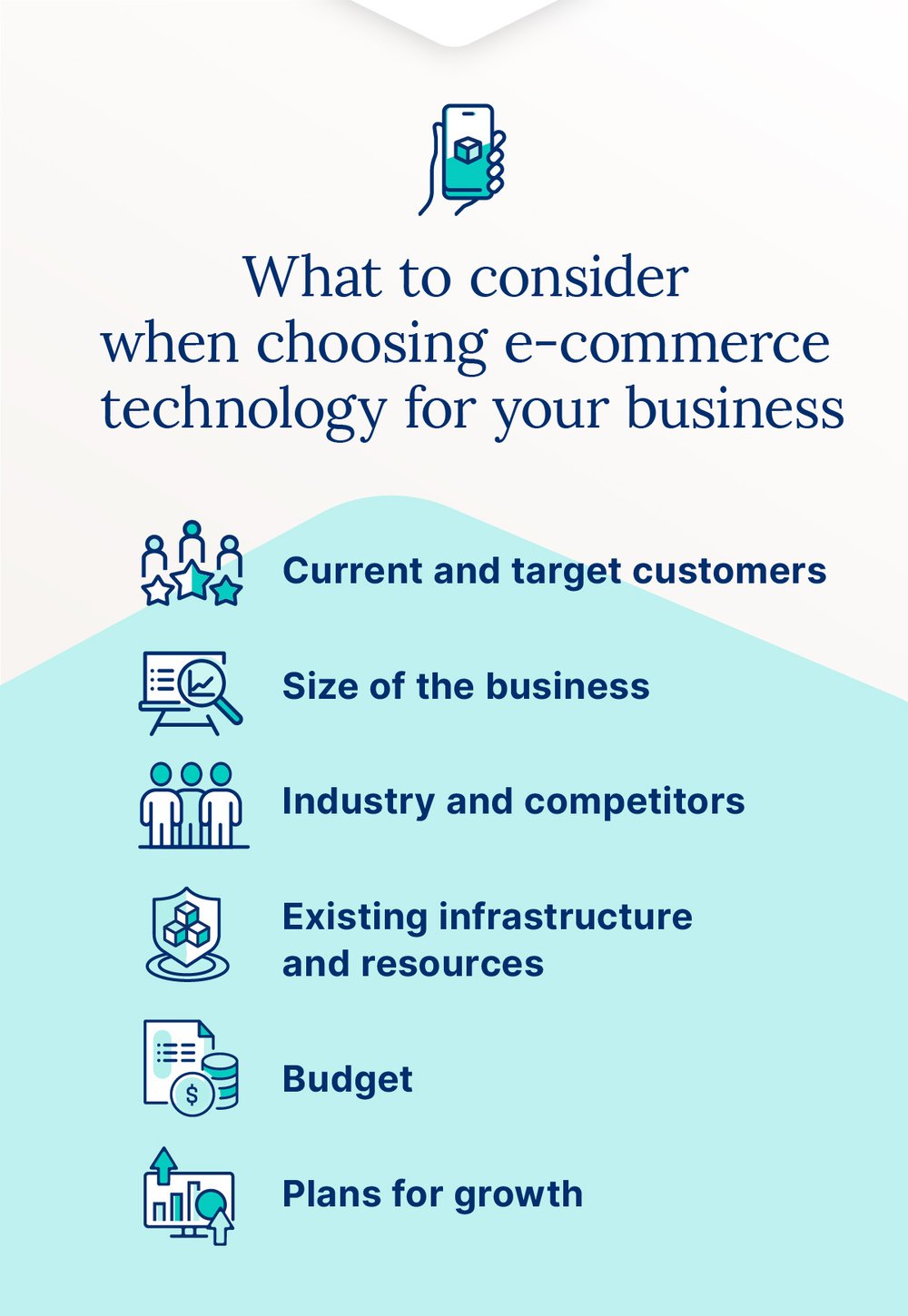
Here's the thing, while staying on top of trends matters, not every trend will be right for your business. What makes sense for you depends on what you sell, who you sell to, and what resources you've got to work with. Here are the other factors worth weighing:
- Current and target customers: Who are your customers today, and who do you want to reach next? Think about what'll genuinely improve their experience and earn their loyalty.
- Size of your business: Some trends are naturally better suited to larger businesses with bigger budgets, while others are perfect for smaller, more agile teams. Don't overextend. Focus on what fits.
- Industry and competitors: What are your competitors doing? Industry-specific trends should guide your decisions. If everyone in your space is adopting a certain technology, there's probably a good reason.
- Existing infrastructure and resources: Before chasing shiny new tech, take stock of what you already have. Can you improve or build on your current systems first?
- Budget: Let's be real, your budget matters. Consider both the upfront costs and the long-term expenses before committing to anything.
- Plans for growth: If you're planning to scale, you'll want technology that grows with you. A solution that works today but can't handle tomorrow's volume isn't a smart investment.
Invest in the Right E-Commerce Technology with Cin7
With so many e-commerce trends to keep up with, from AI-powered shopping agents to multi-channel selling, it helps to have a solid foundation. And that starts with knowing exactly what's in your inventory, where it is, and where it's going.
That's where we come in. Our inventory management software helps your online business eliminate overstocking and stock outages so you can stay on top of customer needs even when e-commerce moves fast (and it always does).
Book a demo with Cin7 and see how we can help you keep pace with the future of e-commerce.
Frequently Asked Questions
Discover answers to the top frequently asked questions about e-commerce technology and trends.
What is e-commerce?
E-commerce, or electronic commerce, is the process of buying and selling goods or services over the internet. It encompasses everything from browsing online stores to securely transferring payment and data to complete the transaction. Often referred to as the sale of physical products online, e-commerce also describes any commercial transaction facilitated via the internet.
What are the different types of e-commerce businesses?
There are four main e-commerce models that cover almost every kind of online transaction:
- Business to Consumer (B2C): A company sells directly to individual shoppers — think any online retail store you've ever ordered from.
- Business to Business (B2B): One business sells to another, like a wholesaler supplying products to a retailer.
- Consumer to Consumer (C2C): People sell directly to each other — platforms like eBay or Facebook Marketplace are classic examples.
- Consumer to Business (C2B): Individuals offer products or services to companies, like freelancers pitching their skills or influencers partnering with brands.
How can I incorporate AI into my e-commerce strategy?
AI has a growing list of uses in e-commerce — and it's evolving fast. You can use AI to retarget potential customers, create marketing campaigns, service customers with advanced chatbots, automate accounting, and forecast demand more accurately.
In 2026, one of the biggest developments is agentic commerce — where AI agents can search for, compare, and even purchase products on behalf of customers. That means optimizing your product content for AI-driven discovery is becoming just as important as traditional SEO. Start by identifying the areas of your business where AI can save you the most time or create the best customer experience, and build from there.
How can I keep up with the latest e-commerce trends?
Staying current doesn't have to feel like a second job. Here are a few easy ways to keep your finger on the pulse:
- Subscribe to industry newsletters: Publications like Digital Commerce 360 deliver trends straight to your inbox.
- Listen to e-commerce podcasts: A great option if you're always on the go.
- Follow thought leaders on LinkedIn: Real-time takes from people inside the industry.
- Join online business communities: Swap ideas, ask questions, and learn what's working for other sellers.
- Watch your competitors: See what technologies and strategies others in your space are adopting — it's one of the fastest ways to spot what's worth testing.
What are the current trends in e-commerce?
E-commerce is moving fast, but a few key trends are leading the charge right now:
- Mobile commerce (m-commerce): More shoppers are buying directly from their phones, making mobile optimization a must.
- Artificial intelligence: AI powers everything from personalized product recommendations to automated customer support.
- Chatbots and live chat: Instant support tools that keep customers happy and help move them through the sales funnel.
- Augmented and virtual reality (AR/VR): Letting shoppers "try before they buy" online — and it works. Studies show AR/VR can increase purchase intent by up to 53%.
- Smarter supply chain tech: Tools like EDI, blockchain, and 3PL/4PL integrations are making fulfillment faster and more reliable.
- Voice commerce: Hands-free shopping via smart devices is growing, especially for repeat purchases.
- Data privacy and security: Customers care about where their data goes — and businesses that invest in security build more trust.
The short version? If it makes shopping easier, faster, or more secure, it's probably trending right now.
What are the 7 C's of e-commerce?
The seven C's are Context, Commerce, Connection, Content, Community, Customization, and Communication—elements that drive website speed, user-friendliness, and visual appeal. A successful e-commerce site balances all seven to create engaging experiences that convert visitors into customers.
What is the 80/20 rule in e-commerce?
The 80/20 rule (Pareto Principle) means that approximately 80% of your revenue comes from about 20% of your customers. This principle helps businesses identify their most valuable customer segments and focus resources on retaining and serving them effectively.
What are the 5 C's of e-commerce?
The 5 C's—Customer, Content, Context, Convenience, and Conversion—form a framework for optimizing marketing efforts. This approach helps businesses create targeted campaigns that address customer needs at every stage of the buying journey.
More from the blog
View All Posts
10 e-commerce trends for fashion and apparel in 2024
Read More
10 essential e-commerce technology for food and beverage to implement in 2024
Read More