









The best ERP for Shopify depends on your size and complexity. NetSuite, Microsoft Dynamics 365 Business Central, and Acumatica lead for complex mid-market brands, while many growing brands do better with Cin7. We're an inventory management system (IMS), sometimes called "ERP lite," that acts like an ERP while letting you keep QuickBooks or Xero.
Does this sound familiar? Shopify orders are flooding in, Amazon wants its share, and wholesale buyers keep emailing POs. Meanwhile, your 3PL's stock count never agrees with yours. You know you need software to help.
Here's the catch: buying too much system hurts as much as buying too little. Overbuy and you'll pay to configure features you won't touch for years. Underbuy and you're back in spreadsheets by next quarter.
In this guide, we'll walk you through a stage-based framework, a side-by-side comparison table, and real published costs and timelines. Let's find your fit!
Key Takeaways
- Shopify isn't an ERP, so growing brands add one, or an IMS, as their operations get more complex.
- Full ERPs like NetSuite, Business Central, and Acumatica suit multi-entity, finance-heavy brands.
- An IMS (ERP lite) like Cin7 handles inventory, orders, purchasing, and wholesale while you keep QuickBooks or Xero.
- Panorama's 2026 survey of 170 mostly mid-market organizations found a 9-month median ERP timeline, with about 30% over budget.
- Choose by stage, channels, and finance needs, not by brand name.
What Is a Shopify ERP (and Does Shopify Have One)?
Shopify doesn't have a built-in ERP. Shopify describes itself as a commerce platform, and plenty of brands run it alongside an ERP. It handles your storefront, checkout, and basic inventory.
An ERP (enterprise resource planning) system goes much wider. It pulls finance, purchasing, inventory, supply chain, and often manufacturing into one shared database. Your general ledger, the master record of your books, sits at its center.
An IMS, or "ERP lite," zeroes in on the product side of your business. It manages inventory, orders, purchasing, warehouses, wholesale, and reporting, then connects to your accounting software for the books. That's how we describe Cin7: an inventory management system, sometimes called ERP Lite or an ERP for Small Business.
Here's what each option owns:
| Option | What It Owns | What It Leaves to Other Systems |
|---|---|---|
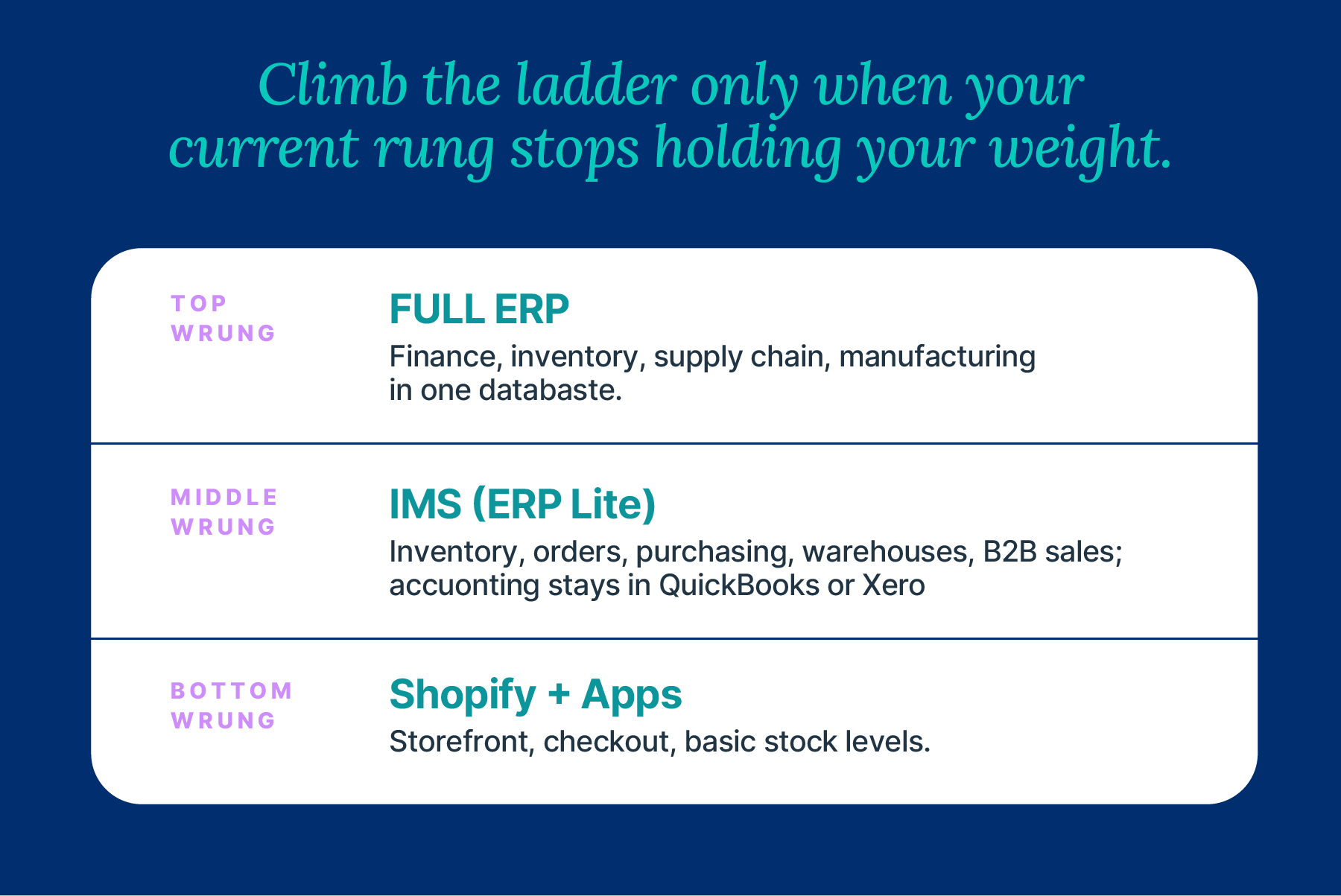
| Shopify + apps | Storefront, checkout, and basic stock levels | Purchasing, wholesale, multi-warehouse planning, and accounting |
| IMS (ERP lite) | Inventory, orders, purchasing, warehouses, B2B sales, and reporting across channels | The general ledger, which stays in QuickBooks or Xero |
| Full ERP | Finance, inventory, supply chain, and often manufacturing in one database | Your storefront, which Shopify still runs |
Think of it as a ladder. You only climb to the next rung when the current one stops holding your weight.
Signs Your Shopify Store Has Outgrown Apps and Spreadsheets
You've outgrown apps and spreadsheets when your team spends more time fixing inventory data than using it. Watch for these telltale signs:
- Shopify, Amazon, wholesale, and POS each show different stock levels, so you oversell one week and stock out the next.
- Your 3PL's counts never match yours, and nobody can say which number is right.
- Someone re-keys orders into another system every day, and month-end reconciliation turns into a marathon.
- Wholesale buyers keep asking for B2B ordering, custom price lists, or EDI.
- You reorder by gut feel because pulling sales data from three systems eats the whole afternoon.
Those stockouts cost more than one sale. In an AlixPartners 2024 holiday survey, about two-thirds of respondents said they'd shop elsewhere if an item was out of stock.
Full ERP vs. ERP Lite: Choosing the Right Level of System
The right system is the smallest one that solves today's problems and leaves room for the next two years. Here's how the three stages break down.
Stage 1: Shopify Plus Apps
Selling on one channel from one location with a simple catalog? Shopify's built-in inventory, a few apps, and your accounting software can be enough. It's affordable and quick to set up.
Just know the ceiling. Each app owns a slice of your data, and they don't always agree. Once you add a second sales channel, a wholesale arm, or a 3PL, the duct tape starts to show.
Stage 2: An Inventory Management System (ERP Lite)
This is the stage for multichannel brands. You're selling on Shopify plus Amazon, wholesale, or retail, shipping from several warehouses or a 3PL, and buying from multiple suppliers.
An IMS acts as the bridge between your sales channels and your books. It syncs stock across every channel, automates purchasing and reorders, and can run a B2B portal for wholesale buyers. Your accounting stays in QuickBooks or Xero, so your bookkeeper doesn't have to learn a new system.
Go-live tends to be faster because there's less to configure; Cin7 customer Second Skin Audio went live in about a month. We see plenty of growing multichannel brands land right here.
Stage 3: A Full ERP
You need a full ERP when finance becomes the hard part. Think multiple legal entities or currencies that need consolidated books, complex manufacturing, a dedicated finance team, or audit and compliance requirements.
Panorama Consulting Group's 2026 ERP Report classes NetSuite and Acumatica as systems that typically serve organizations with $10 million to $250 million in revenue. That's Panorama's classification, not a hard rule.
Still, if you're below that range with a single entity, a full ERP may be more system than you need right now.
The Best ERP Options for Shopify, Compared
Shopify's Global ERP Program lets a select group of ERP partners build direct integrations into the Shopify App Store. It currently lists five certified apps: Oracle NetSuite, Microsoft Dynamics 365 Business Central, Brightpearl by Sage, Acumatica, and Infor. Here's how the most common options (plus two outside the program) stack up.
Oracle NetSuite
NetSuite is best for complex, multi-entity mid-market brands that need deep finance and consolidation. Its certified Shopify connector is listed "from $199.92/month" in the Shopify App Store, and the B2B tier costs $916.58/month.
That's the Shopify-side connector fee only. Oracle bills the NetSuite license and other charges separately, so expect a quote. Plan for a project that runs for months if not over a year.
Microsoft Dynamics 365 Business Central
Business Central is best for teams already living in Microsoft tools. Microsoft lists Essentials at $80 per user per month and Premium at $110, paid yearly (US list, license only).
Its Shopify app is a certified Global ERP Program app and free to install on the Shopify side. Microsoft sells Business Central through partners, so budget for implementation on top of licenses.
Acumatica
Acumatica is best for distribution and operations-heavy brands with lots of occasional users, like warehouse staff who log in for a few tasks. Rather than charging for user seats, Acumatica offers unlimited users and prices by applications and usage, plus resource needs and deployment preferences. An Acumatica partner explains the costs.
It's a certified Global ERP Program app. Panorama places it in the same $10 million to $250 million tier as NetSuite.
Odoo
Odoo is a modular, open-source suite where you switch on only the apps you need. Odoo's own Shopify connector app, built by Odoo Inc, is listed at $100/month in the Shopify App Store. It's available only to US and Canada merchants and works with Odoo.sh and on-premises hosting, not Odoo Online.
The trade-off is setup. Plan for setup time, since the connector only works with Odoo.sh or on-premises hosting, which you'll need to run and maintain. Odoo isn't in Shopify's Global ERP Program, so it connects to Shopify through apps.
Cin7 (Inventory Management System)
Let's be upfront: Cin7 isn't an ERP. We're an IMS, sometimes called ERP Lite, built for multichannel brands that aren't ready for (or don't need) full ERP finance.
Cin7 offers a direct, two-way, real-time Shopify sync for stock, orders, products, and returns, including multiple Shopify stores and Shopify POS. We connect with 700+ platforms, including Amazon, QuickBooks, and Xero, so your books stay where they are.
The B2B Portal and ForesightAI forecasting are add-ons, and EDI and 3PL connections run through our API and partner solutions. Pricing starts at $349/month on the Standard plan (5 users, 2 integrations).
Where aren't we the right fit? If you need multi-entity general ledger consolidation or global accounting, a full ERP is the better call.
Shopify ERP Comparison at a Glance
| System | Best For | Shopify Connection | Published Starting Price | Typical Go-Live |
|---|---|---|---|---|
| Oracle NetSuite | Complex, multi-entity mid-market brands | Certified Global ERP app | Connector from $199.92/mo; license by quote | Months (Panorama median: 9) |
| Microsoft Dynamics 365 Business Central | Microsoft-centric teams | Certified Global ERP app | $80/user/mo (Essentials, license only) | Months (Panorama median: 9) |
| Acumatica | Distribution-heavy brands with many occasional users | Certified Global ERP app | Unlimited users; quote based on apps and usage | Months (Panorama median: 9) |
| Odoo | Teams with technical help on hand | Odoo-built Shopify app (US/Canada) | Connector $100/mo; Odoo license separate | Varies by hosting and scope |
| Cin7 (IMS) | Multichannel brands keeping QuickBooks or Xero | Direct two-way, real-time sync | $349/mo (Standard plan) | About a month in one customer example |
Prices are US list rates from vendor pages and the Shopify App Store, so confirm them before you buy.
What a Shopify ERP Really Costs (and How Long It Takes)
The sticker price is only the start. You'll pay for licenses, connectors, and implementation, and implementation is where time and budgets tend to stretch.
License and Connector Fees
NetSuite's Shopify connector runs $199.92 to $916.58 a month, before the NetSuite license Oracle quotes separately. Business Central costs $80 or $110 per user per month for Essentials or Premium, with $8 Team Member seats for light users.
Per-user pricing grows with your team. Ten Premium users on Business Central comes to $1,100 a month in licenses alone, before a partner touches the setup.
Cin7 prices by plan instead. Per our pricing page (US list, new customers), Standard is $349/month for 5 users, 2 integrations, and 6,000 orders a year. Pro is $599 (10 users, 4 integrations, 24,000 orders) and Advanced is $1,199 (15 users, 6 integrations, 120,000 orders).
Add-ons like ForesightAI, the B2B Portal, and POS cost extra. If you sell on Shopify and Amazon, those two channels use both Standard-plan integrations.
Implementation Time and Overrun Risk
ERP projects often take the better part of a year, and overruns are common. Panorama Consulting Group's 2026 ERP Report (data collected January 2025 through January 2026) found a 9-month median project timeline.
About half of projects (50.6%) stayed on budget, while roughly 30% ran over: 22.9% slightly and 7.1% significantly. Among over-budget projects, the top reason was needing additional technology (54.9%).
Schedules fared a bit better. Most projects (58.8%) finished on time and 18.8% finished early, while 22.3% ran late, most often because of organizational issues (57.9%).
One caveat: the same Panorama survey covered 170 organizations with a median annual revenue of $200.5 million. Your $5M Shopify brand will run a smaller project, but the lesson travels well. Scope creep and people issues push projects off track more often than the software does.
How Shopify Connects to Your ERP or IMS
Shopify connects to your ERP or IMS in one of three ways. Pick the simplest one that keeps data flowing both ways in real time:
- Certified or direct connectors are prebuilt links between Shopify and the other system, like the five Global ERP Program apps.
- Middleware is a go-between service that translates data from one system into a format the other understands.
- Custom builds are integrations your developers write from scratch, giving you full control and full maintenance duty.
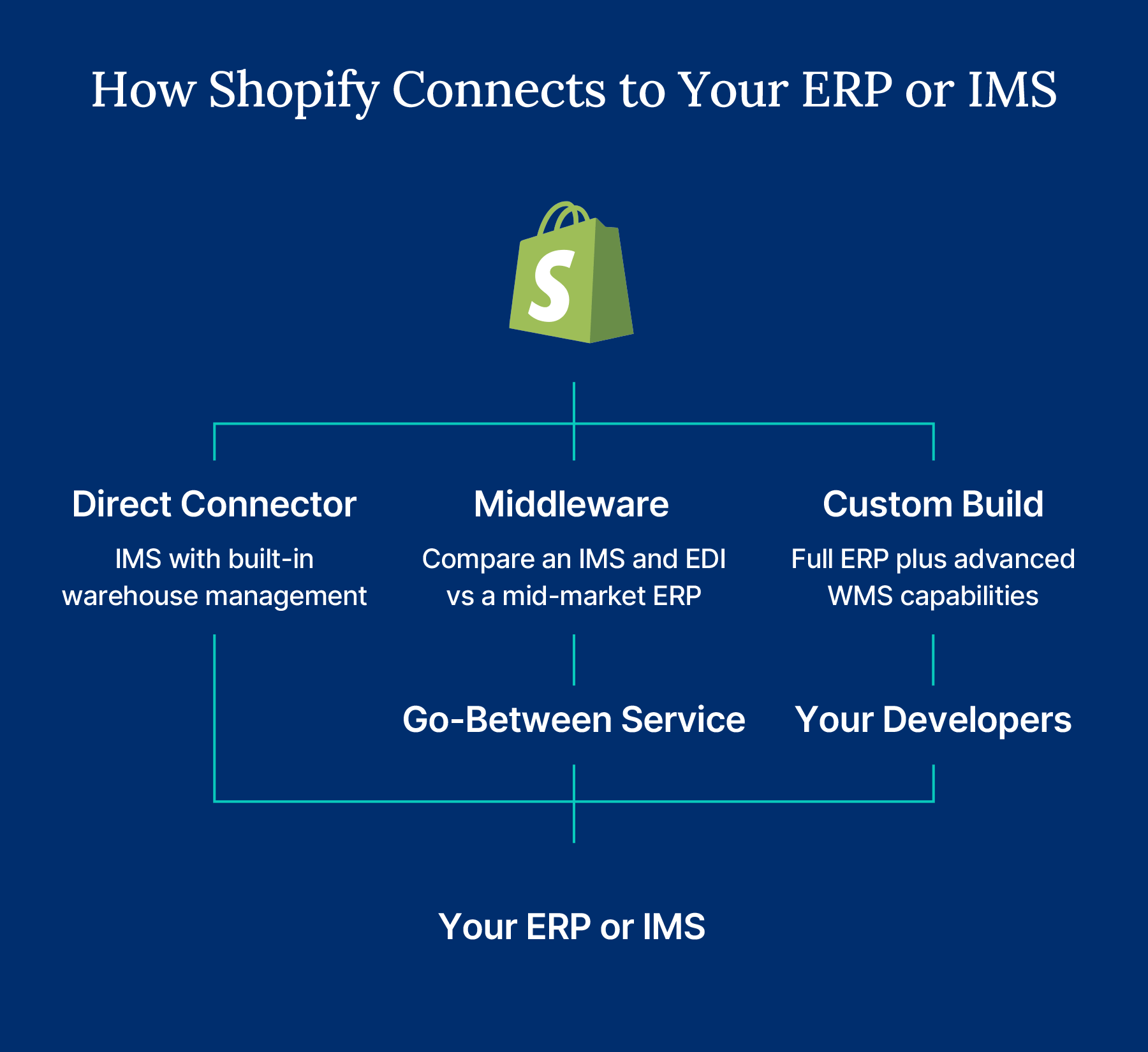
Direct connectors are usually the quickest to launch. Middleware adds flexibility, but it also adds another subscription and another place for things to break. Custom builds make sense when nothing off the shelf fits.
Next, decide which system owns your inventory counts. Pick one source of truth, usually your ERP or IMS, and let Shopify display what it's told. When two systems both "own" stock, you end up selling the same last unit twice.
Finally, insist on two-way, real-time sync, so orders flow in and stock levels flow out within moments. Cin7's direct Shopify integration works this way, syncing stock, orders, products, and returns in both directions.
Real-World Example: How Decibullz Swapped a Failed ERP for a System That Works
Bigger isn't always better, and Decibullz learned that the hard way. The consumer-goods brand went through a failed integration with a large ERP system that "cost time, money, and morale."
CEO Kyle Kirkpatrick wasn't shopping for another big promise. He wanted software that simply worked.
After switching to Cin7, Decibullz got a flexible, connected system. The company reports that new employees now get up to speed in a single day. The team also integrates freely and adjusts its tech stack without missing a beat.
"What we like about Cin7 is that it does what it is supposed to do, in the way that it is supposed to do it," Kirkpatrick says.
The lesson for your Shopify store? Right-size first. A system your team actually uses beats a heavyweight ERP project that stalls halfway.
How to Choose the Best ERP for Your Shopify Store
Start with your operations, then look at vendors. Work through these six steps before you book a single demo:
- Map your channels and locations. List every place you sell and every place you hold stock, including 3PLs.
- Decide what finance needs. A single entity on QuickBooks or Xero points to an IMS; multiple entities or currencies point to a full ERP.
- List your must-have integrations. Shopify, Amazon, your 3PL, and your accounting software belong at the top.
- Set a realistic budget. Include licenses, connector fees, add-ons, and implementation, plus a buffer for overruns.
- Ask for a demo using your own data. Bring real SKUs, order volumes, and your messiest workflow, then watch how each system handles it.
- Start with one problem, then expand. Fix multichannel stock sync or reordering first, prove the win, and add the next workflow after.
Do this homework, and the best ERP for Shopify (or the best IMS) practically picks itself. Your future self, the one not reconciling spreadsheets at midnight, will thank you!
FAQ: Best ERP for Shopify
Does Shopify Have a Built-In ERP?
No. Shopify is a commerce platform that runs your storefront, checkout, and basic inventory, so growing brands add an ERP or IMS as operations get complex. The "What Is a Shopify ERP" section above explains the difference.
What Is the Best ERP for a Small Shopify Business?
For many small Shopify businesses, a full ERP is more than you need right now. An IMS (ERP lite) like Cin7 covers multichannel inventory, purchasing, and wholesale while you keep QuickBooks or Xero. Move to a full ERP when you need multi-entity finance.
How Much Does Shopify ERP Integration Cost?
Costs vary by system. NetSuite's Shopify connector is listed at $199.92 to $916.58 a month, plus a separately quoted license. Several other Global ERP Program apps are free to install on Shopify, but implementation and ERP-side charges come on top.
How Long Does an ERP Implementation Take?
Most ERP projects take the better part of a year, and smaller, simpler projects may move faster. The Implementation Time and Overrun Risk section above breaks down Panorama's latest figures. IMS rollouts can be shorter; Cin7 customer Second Skin Audio went live in about a month.
What's the Difference Between an ERP and an Inventory Management System?
An ERP runs finance, purchasing, inventory, and supply chain in one database, with the general ledger at its core. An inventory management system focuses on stock, orders, purchasing, warehouses, and wholesale. It then hands the accounting to QuickBooks or Xero.
Can I Keep QuickBooks or Xero If I Add an ERP-Style System?
Yes, if you choose an IMS. Cin7 connects to Xero and QuickBooks Online, so your books stay put while inventory and orders run through Cin7. A full ERP typically replaces your accounting software, since its general ledger is the core.
Find Your Right-Sized System With Cin7
Here's the twist: the best ERP for Shopify might not be an ERP at all, at least not yet. If your pain is multichannel inventory rather than multi-entity finance, an IMS gets you there faster.
That's where we come in. Cin7 is an IMS (ERP lite) that brings your multichannel inventory, purchasing, B2B sales, and ForesightAI forecasting into one place. With 700+ integrations, we connect Shopify, Amazon, and the QuickBooks or Xero account you already trust.
Just ask Decibullz CEO Kyle Kirkpatrick, who left a failed ERP integration behind. "It works every time and it's easy to understand," he says.
Ready to see how Cin7 handles your SKUs and order volumes? Get a demo and let's right-size your stack together!