

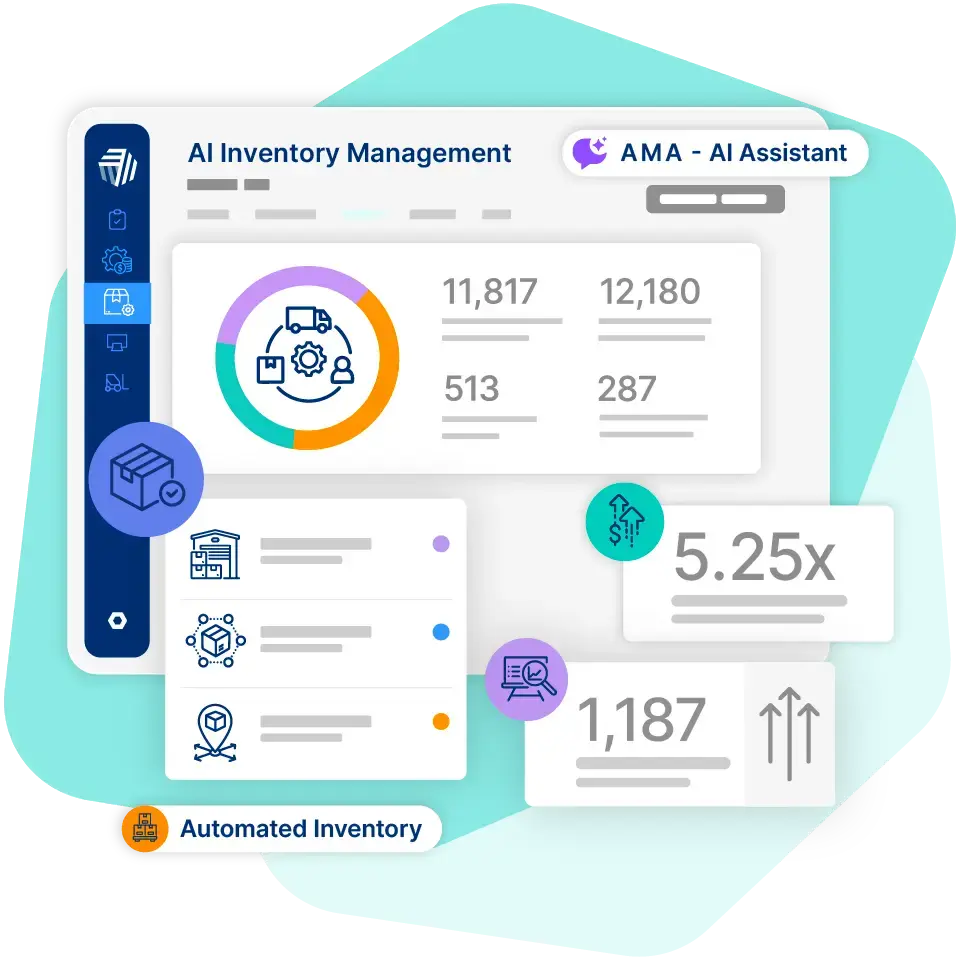


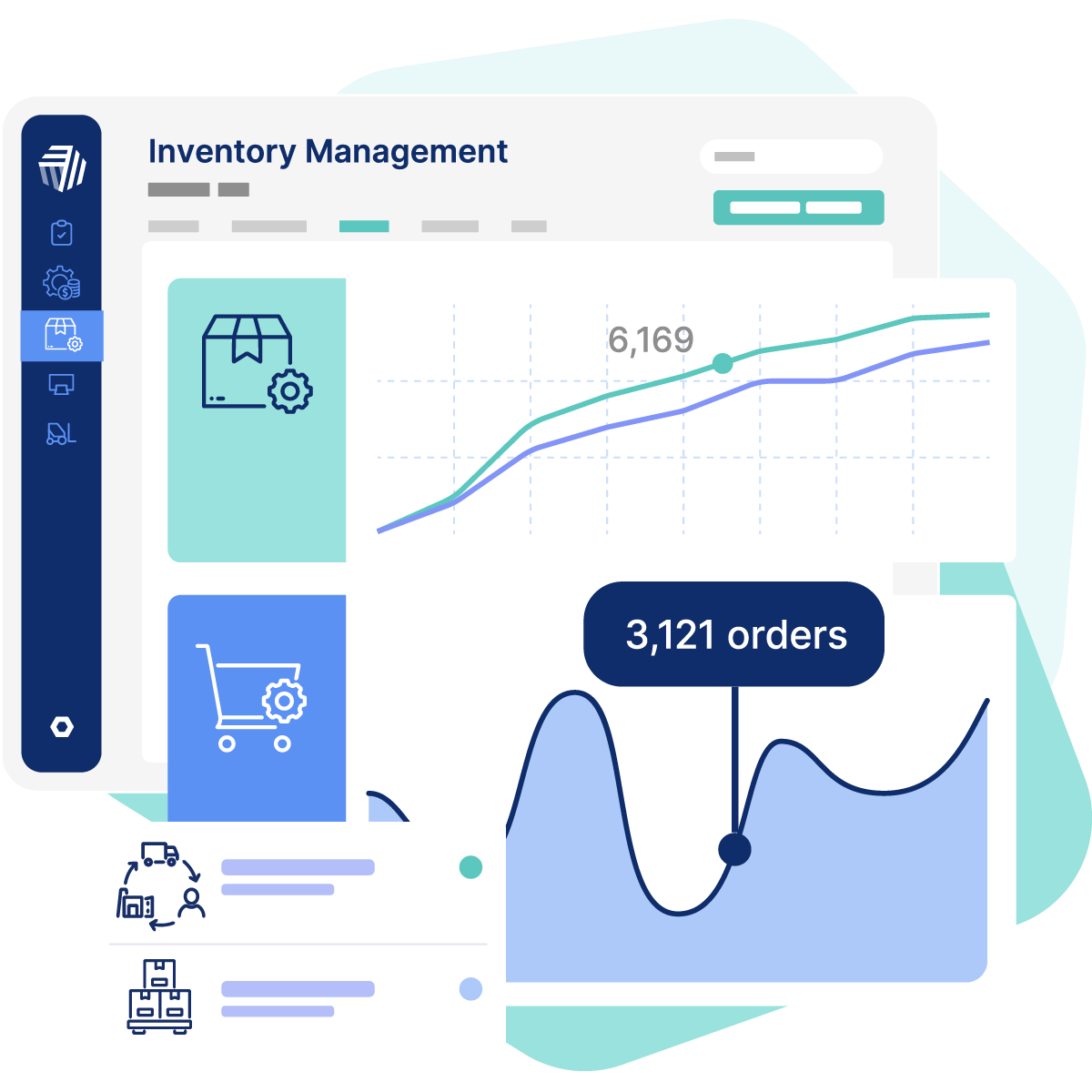




AI demand planning uses machine learning and predictive analytics to forecast future product demand with greater accuracy than traditional methods.
By analyzing historical sales data, seasonal patterns, market trends, and real-time signals, AI-powered demand planning software helps product businesses maintain optimal inventory levels, reduce stockouts, and improve cash flow.
As a small or midsized business (SMB), you already know the stakes. According to the United Nations, SMBs make up:
- 90% of businesses worldwide
- 60-70% of employment
- 50% of GDP
Being the backbone of the global economy is a complex, challenging responsibility, and it gets harder when you're under constant pressure from rising costs, lean teams, and supply chain disruptions. Predicting future customer demand so you have the right amount of product, not too much, not too little, is one of the toughest parts of running a product business. And if you're still relying on outdated tools, it's even harder than it needs to be.
The good news? AI demand forecasting is changing the game for SMBs, giving you access to the kind of accuracy and speed that used to require enterprise budgets and dedicated analysts.
Key Takeaways
- AI demand planning analyzes historical data, seasonal trends, and real-time signals to produce more accurate, SKU-level forecasts than manual or spreadsheet-based methods.
- According to McKinsey, AI-powered supply chain forecasting can reduce errors by 20-50% and cut product unavailability by up to 65%.
- The right AI demand planning tool connects directly to your inventory management system, so forecasts flow into purchasing and replenishment without extra steps.
- We built ForesightAI inside Cin7 to give SMBs enterprise-grade AI inventory forecasting without the complexity or cost of a standalone solution.
What Is AI Demand Planning?
AI demand planning is the process of using artificial intelligence, specifically machine learning algorithms, to predict how much of each product you'll need to meet future customer demand. Unlike traditional forecasting, which relies on manual data pulls and static models, AI demand forecasting continuously learns from your sales history, promotional activity, seasonality, marketplace trends, and even anomalies to refine its predictions over time.
For product businesses, that means fewer gut-feel decisions and more data-driven confidence. You get forecasts that update as conditions change, not just at the end of the month or quarter.
AI Demand Planning vs. Traditional Forecasting
Manual forecasting, spreadsheet models, and basic ERP forecasting were built for a slower, more predictable era. You could rely on last year's sales numbers and a rough seasonal adjustment to keep inventory balanced. But omnichannel demand, frequent supply chain disruptions, and shifting customer expectations have made the old way insufficient.
The result? You're leaving money on the table through stockouts, overstock, and inefficient cash allocation. That's why many of today's product businesses are turning to AI inventory forecasting for help.
Here's how the shift plays out in practice:
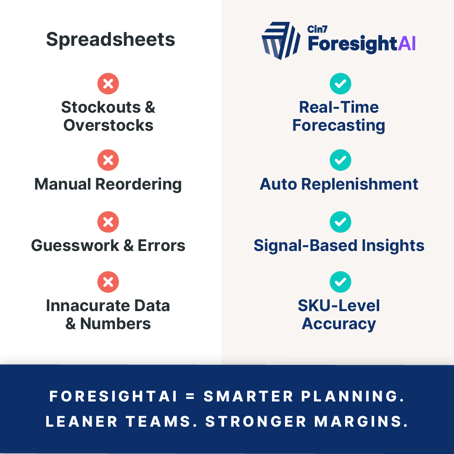
- Forecast frequency: Traditional planning updates monthly or quarterly. AI demand forecasting updates continuously based on real-time performance.
- Data inputs: Traditional methods rely mostly on last year's sales. AI uses dozens of data points, including promotions, seasonality, velocity, marketplace trends, and anomalies.
- Reorder triggers: Traditional systems reorder when inventory hits a fixed threshold. AI predicts the right inventory level and notifies you when to reorder before you run short.
- Team requirements: Traditional forecasting often requires a dedicated team or outside analysts. AI runs the analysis for you, so your teams stay lean.
- Complexity and cost: Traditional advanced forecasting typically requires a full ERP. Modern demand planning software like ours delivers ERP-level forecasting at a fraction of the cost and complexity.
According to McKinsey, AI-powered supply chain forecasting can reduce errors by 20-50% and cut product unavailability by up to 65%. Those are meaningful numbers for any SMB trying to protect margins and keep customers happy.
Benefits of AI Demand Planning for SMBs
AI demand planning isn't just for enterprise brands with massive budgets. It's increasingly accessible to SMBs, and the benefits are tangible.
Greater Forecast Accuracy
AI processes far more variables than any human or spreadsheet can. It detects patterns in seasonal shifts, sales velocity changes, and market trends faster and more reliably. The result is a forecast you can actually trust when making purchasing decisions.
Fewer Stockouts and Less Overstock
When your forecasts are tighter, you carry the right amount of inventory. That means fewer missed sales from out-of-stock products and less capital tied up in items gathering dust on warehouse shelves.
Reduced Manual Work
AI automates the heavy lifting of data analysis, reorder calculations, and purchase order suggestions. Your ops team spends less time on spreadsheets and more time on decisions that actually move the business forward.
Better Cash Flow and Working Capital
Smarter inventory means smarter spending. By reducing excess stock and avoiding emergency orders, you free up working capital and improve your cash position, something every SMB cares about deeply.
Scalability Without Complexity
As your product catalog and sales channels grow, traditional forecasting methods break down. AI scales with you, handling more SKUs, more channels, and more data without requiring you to hire additional analysts.
How to Choose the Right AI Demand Planning Tool
Not all AI demand planning tools are created equal. The most important thing to look for is how well the tool connects to the rest of your operations. Many forecasting tools fail because they don't natively integrate with your inventory management system. They act as siloed applications where data from your sales channels, purchasing, and warehousing can't flow into your forecasts. The result is disconnected decisions and costly mistakes.
When evaluating demand planning software, consider these factors:
- Native integration: Does the tool connect directly to your inventory, sales, and purchasing data, or does it require manual exports and imports?
- Actionable output: Does it just give you a forecast, or does it also generate reorder recommendations and purchase orders you can act on immediately?
- SKU-level detail: Can it forecast at the individual product level, or only at broad category levels?
- Ease of use: Can your existing team use it without a data science background?
- Proven accuracy: Does the tool use multiple algorithms and real customer data to validate its forecasting methods?
Industry Use Cases
AI demand planning delivers value across a wide range of product industries:
- Food and beverage: Perishable inventory leaves zero room for forecasting errors. AI demand forecasting helps you align production and purchasing with actual consumption patterns, reducing waste and ensuring shelves stay stocked with fresh product.
- Fashion and apparel: Seasonal collections, trend-driven demand, and long lead times make fashion inventory notoriously hard to plan. AI identifies shifting velocity and helps you commit to the right quantities before trends peak or fade.
- E-commerce and retail: Selling across multiple channels means demand signals come from everywhere. E-commerce inventory forecasting consolidates data from your online store, marketplaces, and wholesale channels into a single, reliable forecast so you can replenish confidently.
How Cin7 ForesightAI Delivers Smarter Demand Planning
We built ForesightAI to solve a specific problem: SMBs deserve accurate, actionable demand forecasts without the cost and complexity of enterprise tools. ForesightAI lives inside Cin7, which means your forecasting is directly connected to your inventory, sales, and purchasing data. No data silos, no manual exports, no disconnected workflows.
ForesightAI was built to bring real science to demand forecasting. With machine learning as its foundation, our AI demand planning tool takes up to two years of your sales history, runs it through approximately 100 inventory forecasting algorithms, and averages the outputs to produce a highly accurate, SKU-level forecast you can depend on.
Here's what ForesightAI does for you:
- Identifies sales trends and categorizes products as winners (top sellers), losers (underperformers), and chasers (products with growing momentum).
- Calculates optimal reorder points and replenishment quantities automatically.
- Suggests purchase orders directly within Cin7, reducing manual work.
- Triggers POs at the right moments, embedded in the system so nothing falls through the cracks.
- Gives your ops team actionable insights with no data science background required.
The result? Fewer stockouts, less overstock, reduced carrying costs, improved working capital, and smoother purchasing operations.
ForesightAI gives you accuracy without complexity and automation that lightens your workload. You get faster, smarter replenishment that leads to stronger cash flow and profitability. For every product seller who wants to replace disconnected forecasting tools with a single source of truth, ForesightAI is a difference maker. It works seamlessly with all of our modules and saves you time without the need for dedicated analysts.
Our customer CaliWoods experienced these benefits firsthand.
"ForesightAI lets me see what we have in stock and know what we need to order per supplier with a click of a button. We're able to make sure that our stock is accurate to the day. It takes the manual errors out of it, it saves us time, and it saves us money in terms of not running out of stock or not ordering too much."
Founder and owner Shay Lawrence describes our AI demand planning tool as "super, super helpful." She adds: "It's also interesting to see which products are winners, losers, or chasers. The data tells you what you don't know. For example, one of our winners was a personal care product that I never would have thought would be one, and it made us take a closer look at what's moving fast, and which ones are profitable."
Frequently Asked Questions
What Is AI Demand Planning?
AI demand planning is the use of machine learning and predictive analytics to forecast future product demand. It analyzes historical sales data, seasonal trends, market signals, and real-time inputs to produce more accurate predictions than traditional spreadsheet or ERP-based methods. The goal is to help businesses maintain the right inventory levels, reduce stockouts, and improve cash flow.
How Does AI Improve Demand Forecasting Accuracy?
AI improves accuracy by processing far more data points than manual methods can handle. It factors in promotions, seasonality, sales velocity, marketplace trends, and anomalies simultaneously. According to McKinsey, AI-powered supply chain forecasting can reduce errors by 20-50%. Over time, AI models also learn from new data, so forecasts get more precise the longer you use them.
What Is the Difference Between AI and Traditional Demand Planning?
Traditional demand planning relies on historical sales data, manual analysis, and static models that update monthly or quarterly. AI demand planning uses machine learning to continuously analyze dozens of data sources in real time, automatically adjusting forecasts as conditions change. The result is faster, more accurate predictions with less manual effort.
How Do Small Businesses Benefit From AI Demand Planning?
Small and midsized businesses benefit because AI demand planning reduces the need for dedicated forecasting analysts. It automates reorder calculations, suggests purchase orders, and surfaces insights that help lean teams make smarter inventory decisions. Tools like our ForesightAI are built specifically for SMBs, delivering enterprise-grade forecasting without the complexity or cost.
What Data Does AI Demand Planning Use?
AI demand planning tools typically analyze historical sales data (often one to two years), seasonal patterns, promotional activity, sales velocity across channels, marketplace trends, and external signals like supply chain disruptions. The more connected your data sources are, the more accurate the forecast. That is why integrated tools that connect directly to your inventory and sales systems tend to outperform standalone solutions.
Are you ready to transform your inventory management and demand planning with ForesightAI? Reduce your risk, increase your margins, and scale with confidence. Get a demo today.
More from the blog
View All Posts
Spreadsheets vs. Smart Reorder: What’s the Cost of Guesswork?
Read More
How to Reduce Stockouts, Overstock, and Planning Chaos with AI Forecasting
Read More