Are you trying to figure out how to do demand forecasting manually?
We can help you with that, and we can help you decide if upgrading to an AI-based forecasting process is for you.
Planning a perfect party isn’t easy. It requires finding the right venue and providing the right amount of food and beverage, but of these two party planning must-dos, the latter is the hardest. Ordering enough food and beverage without knowing how much your guests will consume is a tricky business: you don’t want to order too much, or you’ll be stuck with leftovers, and you don’t want to order too little, or your guests will leave hungry and dissatisfied.
Small and midsized businesses (SMBs) like yours struggle with a similar conundrum every day. You’re constantly trying to figure out how much product to order so you have enough on hand to fulfill orders efficiently but not so much that you’re stuck with a warehouse full of unwanted products, thus increasing your holding costs and depleting your cash flow.
This is where demand forecasting comes in!
Today, we’ll unpack what demand forecasting is, including how to do demand forecasting the right way and where AI fits into the picture.
What is Demand Forecasting?
Demand forecasting is the process of predicting future customer demand so a business can order the right products, at the right quantities, at the right time.
Are you noticing the trend here?
You have to be right when it comes to demand, and being right requires analyzing information about your business and your customers. This vital information includes:
- Historical sales data
- Customer trends
- Seasonality
- Promotions
- Lead times
- External factors (e.g., market conditions, supplier reliability, and logistics challenges)
By combining all this information you’ll be able to make the (what’s the word?) right forecasting decisions, which will ultimately improve turnover, working capital, margins, and customer satisfaction.
Sounds easy, right? It can be if you do it right. (We know. Enough with right already!)
How to Do Demand Forecasting Manually
Doing demand forecasting manually can be a complex process, which is why we’ve put together a simple seven-step process just for you. However, before we jump into these seven steps, we need to make one thing clear: manual demand forecasting has its limitations, and we’ll be discussing what these limitations are in a bit.
Step 1: Gather and Clean Your Historical Sales Data
Your forecast is only as good as your data quality. Start by pulling 12–24 months of sales history by SKU, ideally broken down by month or week so patterns emerge. This data forms the raw basis for understanding how demand has behaved over time. Once you have this data pulled it’s time to clean it up. But what does that look like?
When cleaning your data you will:
- Remove anomalies, like stockouts or unusually large one-off orders that skew averages.
- Exclude discontinued SKUs or reset their history once they change packaging or format.
- Standardize units (e.g., sales by units or dollars) so your formulas are comparing apples to apples.
Step 2: Identify Patterns (Seasonality, Trends, Cycles)
Once your data is squeaky clean, it’s time to start searching for patterns.
Look for :
- Seasonality: Does demand rise at the same time each year (summer, holidays)?
- Trends: Is there long-term growth, steady decline, or sideways movement?
- Cycles: Multi-year business cycles or repeating ups/downs.
We recommend graphing your data in charts or pivot tables. A simple line chart or moving average plot instantly reveals patterns, like sales spiking in December every year, that might be invisible in tables.
Step 3: Adjust for External Factors
Historical sales tell you what has happened, but not why. That’s where manual adjustment comes in.
Look at how these impacted demand:
- Promotions or price changes
- Economic shifts like inflation or recession
- Supplier fluctuations
- Holiday spikes
Adjust your expected demand up or down for these events where appropriate. For example, if you know you’re running a major promotion next quarter that didn’t occur last year, you should manually adjust your forecasted figures.
This is where judgment enters. Manual forecasting isn’t “pure math,” it’s informed math plus context.
Step 4: Choose a Forecasting Method
Here are some common forecasting methods you can use in a spreadsheet. Each has pros and cons depending on your data:
- Moving averages: If you want to see if your sales are increasing, slowing down, or doing nothing at all, a moving average lets you average your sales over a historical data period and helps you predict what may be coming your way in the future.
- Weighted averages: To better follow sales trends, you may want to use weighted averages. This forecasting method takes the average sales for the historical data period but gives the periods closest to the current date a higher weight than those further in the past.
- Year-over-year comparisons: Everyone knows comparing apples with oranges doesn’t work and the same goes when comparing your sales from previous years. With year-over-year comparisons, you ensure that you’re comparing the same period sales against as the same period prior. This is useful for revealing trends and setting realistic goals.
- Growth rate projections: If you’re looking to estimate how your customer demand will increase or decrease in the long and short term, growth rate projections are the way to go. This forecasting method will help plan production, order inventory, and use resources.
Step 5: Calculate Forecasted Demand
Now it’s time for formulas and a lot of patience.
Work SKU by SKU, because different products often have different patterns (stable vs seasonal, high vs low volume). Apply your chosen formula across all of your SKUs:
- For moving averages, sum past periods and divide by the number of periods.
- For weighted averages, multiply each period by its weight before summing.
- For growth projections, apply the trend percent to the latest actual sales figure.
Make sure to record your formulas carefully. Your forecasting can’t stay accurate if you mix methods mid-stream without documenting why and how.
Step 6: Translate Forecasts Into Inventory & Purchasing Needs
Once you have forecasted demand at the SKU level, it’s time to translate it into actionable inventory and purchasing figures:
- Factor in supplier lead times: If it takes six weeks for an order to arrive, you need stock on hand earlier.
- Consider Minimum Order Quantities so that you don’t over or under order
- Set reorder points and safety stock manually
- Determine replenishment quantities
You’re now ready to turn your forecasting numbers into real procurement actions and stock levels.
Step 7: Review and Validate
Manual forecasting isn’t “set it and forget it.” You need regular review:
- Compare forecast vs. actual for each month or quarter
- Measure forecasting accuracy using simple metrics like percentage error.
- Adjust formulas or methods when they consistently miss the mark.
Validation is how you learn from your forecasts and improve them over time; without this step, you’re just guessing with spreadsheets.
Limitations of Manual Forecasting
Clearly, manual demand forecasting is doable, especially when you follow the steps we’ve outlined. Yet, when doing manual forecasting, concerns are almost always lurking in the background.
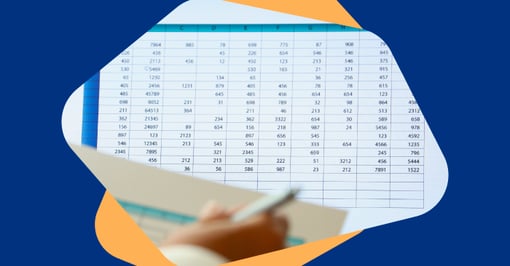
Take, for instance, the errors that occur when you manipulate data manually. Even if you and your team are the most detailed, on-top-of-it people, you may experience communication confusion if you lack standard operating procedures. And data entry mistakes and human errors (think a typo or an extra 0 where it doesn’t belong) are inevitable, hampering your ability to forecast demand accurately.
Something else that is likely also top of mind? The incredible amount of time it takes to manage manual forecasting. What starts as a manageable forecasting process quickly breaks down as SKU counts rise. Spreadsheets struggle to keep up with demand shocks, seasonality changes, and multichannel behavior, and ops teams end up spending more time maintaining forecasts than acting on them.
It’s a lot to take in, but there’s one more important limitation that must be addressed and that’s the fact that manual forecasting doesn’t allow you to update your data in real time. What does this mean? It means that your forecasts, no matter how hard you’ve worked on them or how good they are, will quickly become outdated.
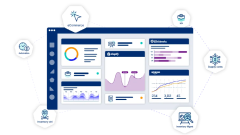
Fortunately, you’re not stuck with these manual forecasting constraints! You can tap into the power of Cin7 and our advanced, AI-driven demand planning tool, ForesightAI, to help you predict demand, automate reordering, and keep your inventory beautifully balanced.
How Cin7 and ForesightAI Ease Your Manual Demand Forecasting Challenges
To fully understand how Cin7 and ForesightAI can transform your demand forecasting process from time-consuming and stressful to efficient and effortless, you must first understand what Cin7 is. Simply put, Cin7 is a modern, scalable, and all-in-one inventory management solution (IMS) designed to serve fast-growing product sellers with complex channels.
Cin7 unifies sales and inventory data, eliminates the need for duplicate data entry and spreadsheet dependency, and centralizes your SKU, BOM, channel, and warehouse data. Having a clean data foundation with Cin7 ensures manual forecasting is more accurate, but even more importantly, a clean data foundation is required before moving to automation or AI forecasting tools, like ForesightAI.
With Cin7’s ForesightAI, which integrates directly with other Cin7 modules, you have a demand planning tool that takes the manual right out of manual demand forecasting. Case in point, the historical data, real-time performance, and emerging patterns you would have to analyze on your own are done automatically. You can anticipate, and enjoy, SKU-level forecasts without requiring formulas or spreadsheets.
You can also expect:
- Automated reorder points and replenishment suggestions
- Elimination of errors from manual spreadsheets
- Saved hours each week for ops and purchasing teams
- Reduced stockouts and overstock with more accurate predictions
And if you’ve needed but been unable to afford data science teams or expensive ERP solutions, then Cin7 and ForesightAI are for you. Together, they’re affordable and advanced technologies that help you automate your demand forecasting process and improve accuracy.
To learn more, request a free ForesightAI demo today!